AI Meeting Prep: What a Good Pre-Meeting Brief Actually Contains
 Justin Canetti9 min read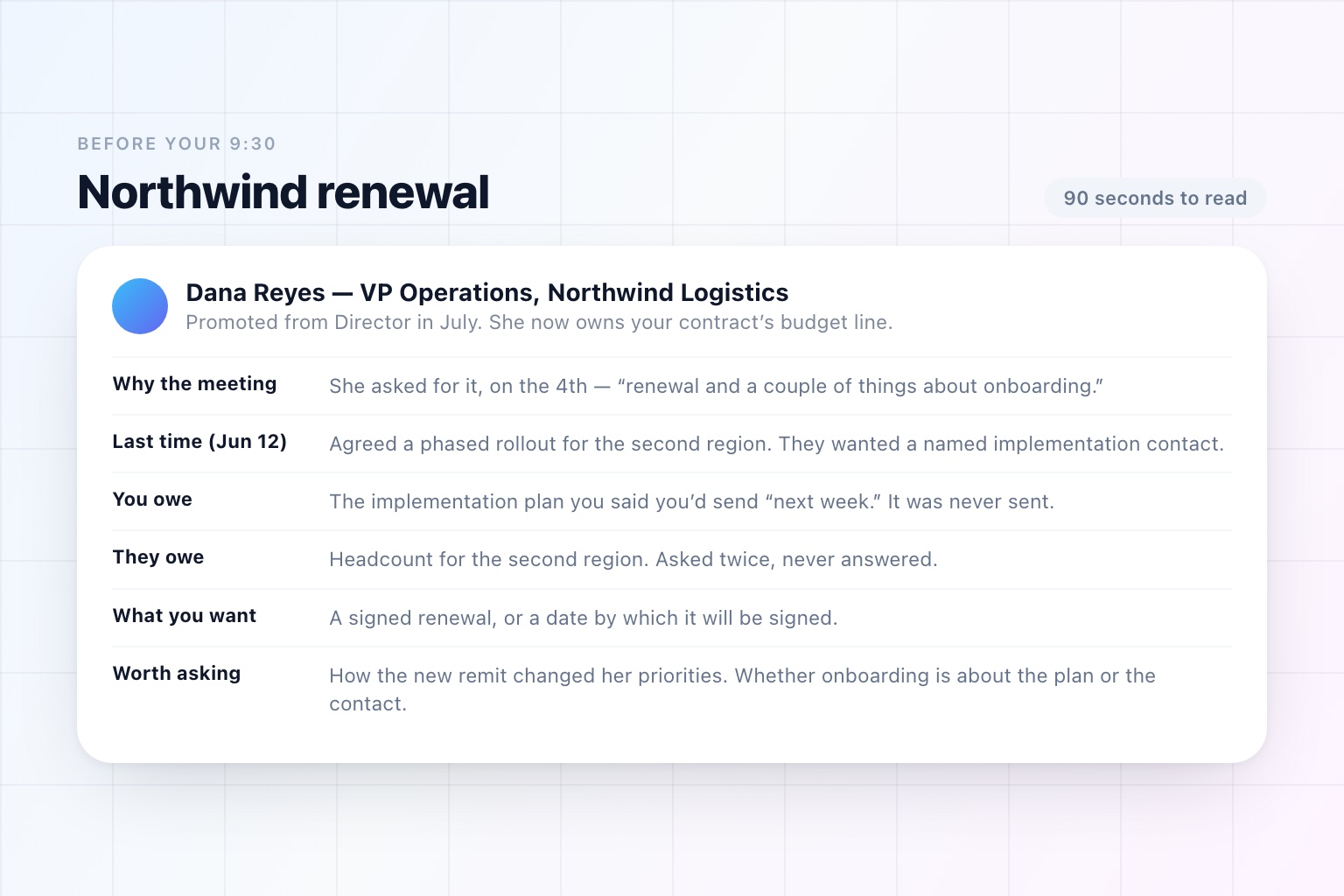
"Be prepared" is the most commonly given and least actionable piece of professional advice there is. Nobody disagrees with it. Almost nobody can tell you what it means concretely enough to do on a Tuesday with five calls stacked back to back.
So in practice, preparation means this: you glance at the calendar entry ninety seconds before the call, recognise the name, maybe open their LinkedIn, and join. You are not unprepared exactly. You are operating on recognition rather than knowledge, which works fine until the meeting matters.
This is a description of what the actual thing looks like — the brief a good chief of staff would hand you in the corridor — and why it has historically been unavailable to anyone who did not employ one.
The Anatomy of a Pre-Meeting Brief
Seven parts. It should fit on a phone screen, and it should be readable in the ninety seconds you actually have.
1. Who they are, and what changed
Role, tenure, what they own, and — the part a static profile misses — what is different since you last looked. A promotion, a funding round, a reorg, a new title that quietly changed who decides.
2. Why this meeting exists
Who asked for it and what they said they wanted, in their words, from the thread that created it. Surprisingly often this alone reframes the meeting.
3. What happened last time
The decision, not the transcript. What was agreed, what was left open, and the sentence somebody said that everything since has been built on.
4. What you owe them
The promise you made in message seven of a long thread. This is the single highest-value line in any brief, and the one you are most likely to have forgotten.
5. What they owe you
The answer you never got, the document that never arrived, the decision that has been pending for eleven days. Walking in knowing this changes who is on the back foot.
6. The one outcome you want
Stated as a sentence, not a topic. "Agreement on a start date" rather than "discuss timeline." If you cannot write it, the meeting may not need to exist.
7. Two questions worth asking
Not a script. Two openers that are specific to this person and this moment, which is the difference between a conversation and an update.
Notice what is not on that list: a summary of the company's business, a recap of the industry, a transcript of the last call. Length is not the goal. A brief that takes ten minutes to read gets skimmed, and a skimmed brief is worse than none because you now believe you are prepared.
A Worked Example
Abstract advice is easy to nod at, so here is the same thing concrete. A renewal call at 2pm with a customer you last spoke to in June.
Dana Reyes — VP Operations, Northwind Logistics. Promoted from Director in July, so this is your first call with her in the new role. She now owns the budget line your contract sits on.
- Why the meeting
- She asked for it, on the 4th, to "talk through the renewal and a couple of things about onboarding."
- Last time (June 12)
- You agreed to a phased rollout for their second region. They wanted a named implementation contact.
- You owe
- The implementation plan you said you would send "next week." It was never sent.
- They owe
- Confirmation of headcount for the second region, asked for twice, never answered.
- What you want
- A signed renewal, or a date by which it will be signed.
- Worth asking
- How the new remit has changed her priorities for next year. Whether the onboarding concern is about the plan or about the missing contact.
That is maybe a hundred and forty words, and it changes the meeting. You now know to lead with an apology and the plan, you know the promotion is why the tone may be different, and you know not to be surprised by the onboarding topic.
Without it, you walk in knowing "Dana, Northwind, renewal" and improvise. The call still happens. It is just a worse call, and you will not know it was worse, because you will have nothing to compare it to.
Why Nobody Does This by Hand
Not laziness. Arithmetic.
Assembling that brief honestly takes fifteen to twenty minutes: search your inbox for the thread, re-read enough of it to find the commitment, check the CRM, look at their LinkedIn, notice the promotion, check whether anything happened at their company, and then decide what you actually want.
Five external meetings a day is an hour and a half of preparation. Nobody has that, which is why the work gets done for the one meeting a month that feels important enough — and the irony is that the important ones are usually the ones where you already carry the context, while the routine ones you skate through are where the forgotten promise is hiding.
There is a second reason, which is that the work is unrewarding. It is searching, cross-referencing, and re-reading — the kind of task where the output is valuable and the doing of it is pure overhead. That combination is the clearest signal there is that something should be delegated.
What the Automation Actually Has to Do
It is worth being precise here, because "AI meeting prep" is being used to describe two quite different things.
The easy version reads your calendar entry and the attendee's public profile and writes you a paragraph. It is better than nothing, and it is mostly a nicer-looking LinkedIn.
The useful version — the kind of AI meeting prep worth paying for — has to reach into places a calendar cannot see:
The public record — who they are, their company, funding, recent news, their history. The homework you would do if you had an hour.
Your own email — what this person last asked for, what you promised, which thread went quiet. This is where the commitments live, and it is the source that makes a brief feel like it was written by someone who was paying attention.
Your notes and CRM — the past meeting notes and the account record, so you never open a call re-reading history.
Your business systems — pipeline, tickets, revenue, hiring, whatever is relevant to this particular meeting and this particular person.
A brief built from the first source alone is a research summary. A brief built from all four is what a chief of staff would hand you, and the difference is entirely in the second one — because the fact that you owe Dana an implementation plan cannot be found anywhere on the internet.
Three Ways Automated Briefs Go Wrong
If you are evaluating this, these are the failure modes worth testing for.
Too long. The most common one. A generated brief wants to demonstrate effort, so it includes the company's founding year and a summary of their product. You will stop reading them within a week. Good briefs are ruthless and get shorter over time, not longer.
Generic. If the brief would read identically for any customer of that size, it is not a brief, it is a template. The test is whether it contains at least one thing you did not already know and could not have guessed.
Stale. A brief written from data that was accurate three months ago is worse than none, because it is confidently wrong in front of a person who knows better. Freshness on the what changed line matters more than depth anywhere else.
Where It Should Arrive, and When
Two practical details that determine whether any of this gets used.
Timing. A brief that arrives at 8am for a 4pm meeting will be forgotten by 4pm. The useful patterns are a daily agenda first thing — every meeting, who is coming, and what you owe people before it starts — plus a per-meeting brief shortly beforehand, when you can still act on it.
Channel. It has to reach you where you will be. On a laptop, email or the app is fine. Walking between meetings, it needs to be a text. The brief you cannot read is identical to the brief that was never written.
And the scope should be yours to set. External calls only is the right default for most people; every meeting is right for some; only the ones you flag is right if your calendar is mostly internal. Similarly for contents — a salesperson wants pipeline on it, a hiring manager wants the candidate's history, and a founder wants both plus the weather in the city they are landing in.
The Real Argument for Prep
Meeting notes tell you what happened. They are genuinely useful and they are a record.
Preparation is the only part of the meeting lifecycle that changes the outcome. The same thirty minutes with the same two people produces a different result depending on whether one of them remembered the promise from June.
For a long time that was a difference in resources — executives had someone who did this, and everyone else improvised. That is the part that has actually changed, and it is a slightly bigger deal than another summary tool.
If you want the tool landscape rather than the argument, we compared it in 7 Best AI Meeting Assistants for 2026.
See it in the product
A brief like that, before every call
Built from the public record, your own inbox, your notes, and your CRM — delivered by email, text, or in the app.
Free plan · No credit card required