AI Scheduling Assistants: Scheduling Was Never a Calendar Problem
 Justin Canetti8 min read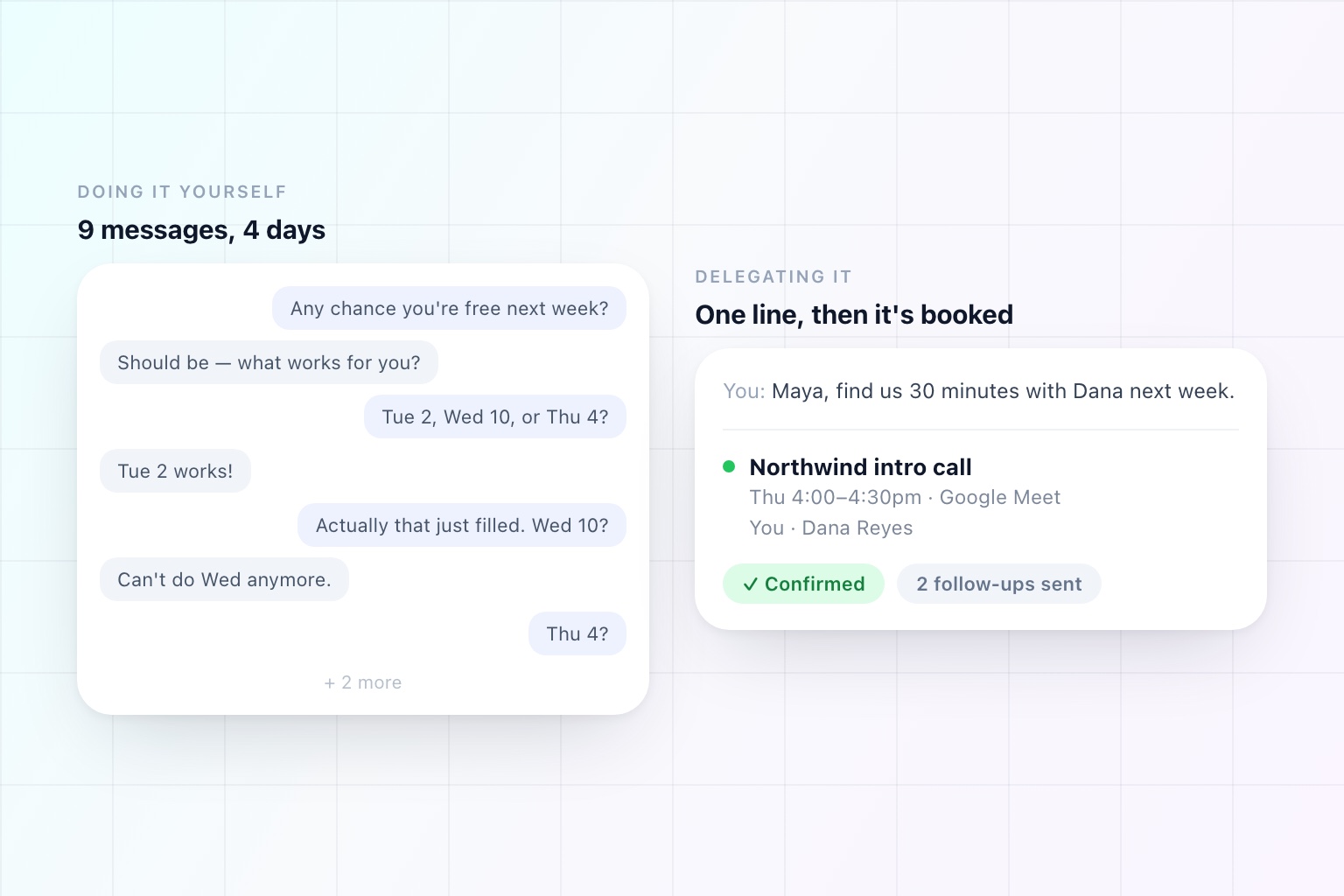
Here is something strange about the last twenty years of software.
Calendars got very good. They sync across devices, across companies, across time zones. They show you free-busy for anyone in your organization. They suggest rooms, attach video links, handle recurrence rules of genuinely baroque complexity, and warn you about conflicts before you create them.
And scheduling a meeting with someone outside your company is still a nine-email thread.
That gap is not an oversight. It is a clue. Twenty years of very smart people worked on this and the problem did not move, which usually means the problem was not what everyone thought it was.
The Wrong Layer
Calendar software optimized the calendar. The calendar is a data structure: a list of blocks with start times, end times, and attendees. It is the output of scheduling.
Scheduling itself happens somewhere else entirely. It happens in a conversation between two people who cannot see each other's calendars, do not share a priority list, and are each quietly deciding how much this meeting is worth.
You can make the data structure perfect and change nothing about the conversation. That is roughly what happened.
Scheduling Is a Negotiation With Missing Information
Look at what you are actually doing when you schedule a meeting with someone at another company.
You do not know when they are free. You can guess at their working hours from their time zone and their job, and that is it.
You do not know what this meeting is worth to them. Are they going to move something for it, or is it going in the first gap they find in three weeks?
You do not know what else is competing for the same slot. A time that is technically free on their calendar may be the only afternoon they had left to write the thing this meeting is about.
And you are making all of these guesses while also managing a small social transaction. Proposing too narrow a window reads as arrogant. Proposing too wide a window reads as disorganized. Following up too fast reads as pushy. Following up too slowly means it does not happen.
That is a negotiation under uncertainty with a reputational component. It is not a data problem. No wonder the calendar could not help.
Every Tool So Far Has Been a Workaround
Once you see scheduling as a negotiation, the entire product category reads differently. Every tool we have built is a way of avoiding the negotiation, because software could not participate in one.
Shared free-busy solved it inside a company by removing the uncertainty — everyone's calendar is visible, so you just book it. It works beautifully and it stops dead at the org boundary, which is exactly where the hard meetings are.
Booking links solved it by refusing to negotiate. Here is my availability; you pick. It is efficient, and it works by moving the entire burden onto the other person, which is why you hesitate before sending one to a customer or an investor. A link is a small assertion that your time is the constrained resource.
Polls solved it by making everyone negotiate at once, asynchronously. This works for eight people who share nothing, and it degrades fast: every additional participant makes a unanimous slot less likely, and the winning time is usually the one everybody could tolerate rather than the one anybody wanted.
"Here are three times that work for me" is the oldest workaround and still the most common. It is also the one that generates the nine-email thread, because two of the three are gone by the time they read it.
Each of these is a genuinely clever response to the same constraint: software cannot read a message from a stranger, understand what they need, weigh it against your priorities, and write back like a person.
That constraint held for two decades. It does not hold anymore.
What Changes When the Tool Can Correspond
An AI scheduling assistant is not a better calendar. It is the first scheduling tool that operates at the layer where scheduling actually happens.
It reads the thread, so it knows what the meeting is for and who asked. It knows your calendar, your working hours, your buffers, and which meetings you protect. It writes to the other person in their own language, proposes times that fit both of you, reads what comes back, and adjusts. When "Thursday doesn't work, could we do the following week?" arrives, that is a normal turn in a negotiation, not an exception that breaks the flow.
Three things follow from that, and they are the parts people underestimate.
The other person does nothing. No link, no account, no plugin, no page to interpret. They receive an email and reply to it, which is what they were going to do anyway.
Silence gets handled. This is the quiet failure of every self-service tool. A booking link that is never clicked does not tell you it was never clicked, and the meeting simply does not happen. An assistant notices the gap and follows up, politely, on a cadence you set, until it is on the calendar.
Nobody has to be efficient. The negotiation still happens. It costs you nothing, because you are not the one having it.
The Honest Objection
If you are going to hand a tool your calendar and let it email people, the first real question is not accuracy. It is permission.
What is it allowed to do? Can it email a customer without me seeing it first? Can it accept a time I would have declined? What happens if it gets something wrong in front of someone who matters?
Those are the right questions, and the answer should be a setting rather than a promise. Autonomy and supervision are something you configure per kind of work: hold everything for approval while you learn to trust it, hold a draft for ten minutes so you can step in before it sends, or hand over the whole negotiation for internal meetings while anything touching a customer still waits for a yes from you.
The point of the dial is that it moves. Most people start conservative, watch it work for a fortnight, and then stop reading the drafts.
What This Means for Calendar Tools
Not that they go away. Free-busy, conflict detection, time zone handling, room booking, recurrence — all of that is infrastructure, and an assistant is a heavy consumer of it. The calendar is not the competitor; it is the substrate.
What changes is where the product value sits. For twenty years the interesting work was in representing time better. From here, the interesting work is in handling the conversation about time, and a company's scheduling tool stops being a page you send people and starts being someone who writes to them.
Which, if you have ever worked with a good executive assistant, is not a new idea at all. It is just the first time it has been available to people who do not have one.
If you want the practical version of this argument, we went through the tools themselves in 8 Best Calendly Alternatives for 2026 and took apart the single worst sentence in scheduling in Why "What Time Works for You?" Is a Terrible Way to Schedule Meetings.
The Test
If you want to know whether your scheduling is a calendar problem or a negotiation problem, ask one question about last week's meetings: how many of them required you to write a sentence to a human being about when?
If the answer is zero, your calendar tool is working and you should change nothing.
If it is not zero, no calendar feature is going to close that gap. It was never the calendar.
See it in the product
Let someone else have the negotiation
Cc your assistant on the thread. It proposes times, handles the replies, follows up on silence, and sends the invite.
Free plan · No credit card required