Best AI Assistants That Make Phone Calls for You (2026)
 Justin Canetti10 min read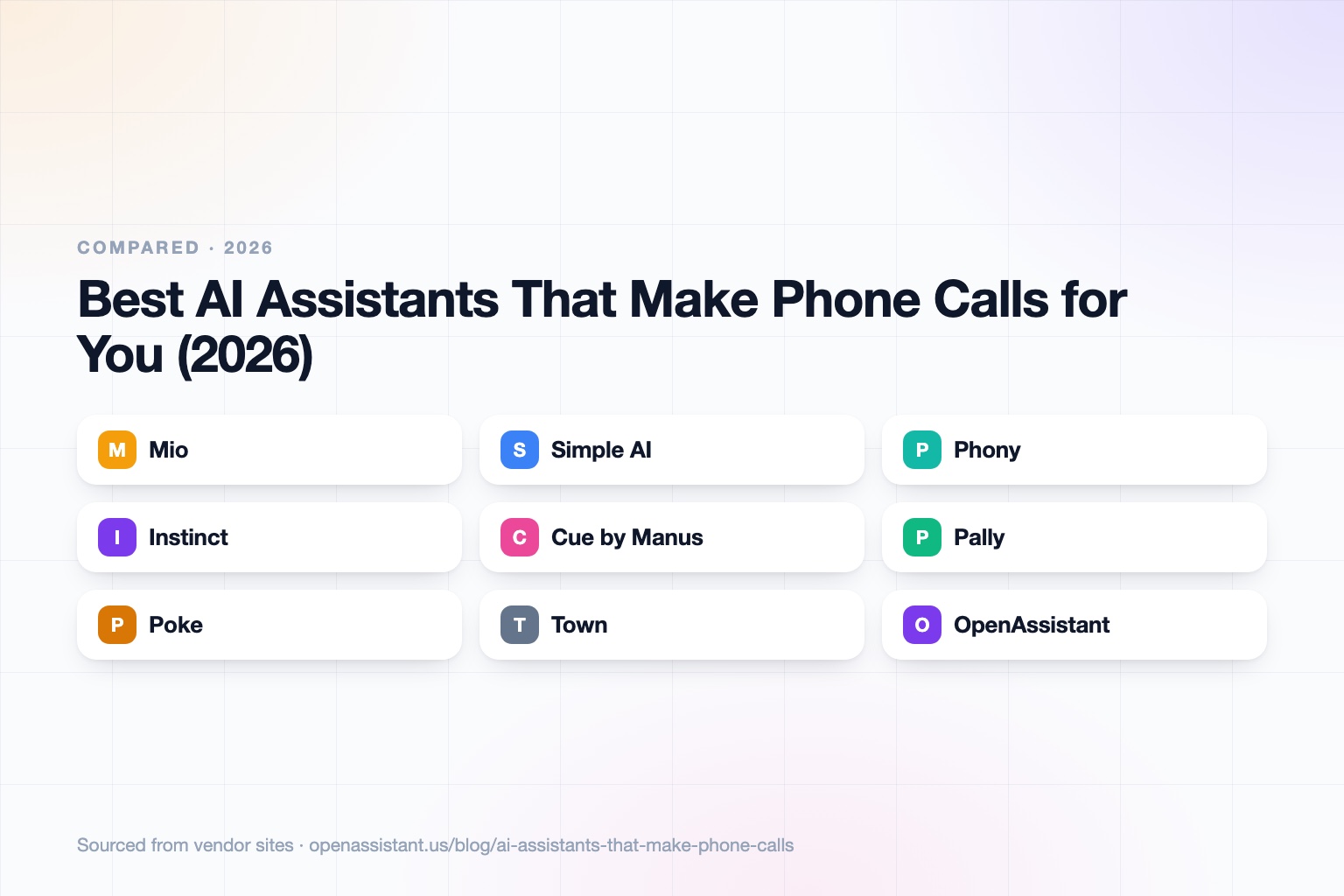
The short answer
An AI personal assistant that can make calls falls into three groups: apps that call businesses for you, assistants with their own phone number, and developer platforms you build on. Pick by whether you want an errand done, an ongoing assistant, or a product to build.
- Best for one-off errands (hold music, rescheduling, reservations): Mio, Simple AI, or Phony.
- Best AI assistant with its own phone number: Instinct or Cue by Manus for personal use, OpenAssistant for work that involves other people.
- Also with a phone number: Pally's Max tier ($100 per month) includes a dedicated phone number and its own email address.
- Text and email first, not call first: Poke is a contact you text and does not describe placing calls itself, and Town has its own @town.com email address but no dedicated phone number that we found.
- Best for developers building voice agents: Retell, Vapi, or Bland.
AI Assistants That Make Phone Calls at a Glance
| Tool | Best for | Key capabilities | Pricing |
|---|---|---|---|
| Mio | Texting a request and getting a call made | Outbound and inbound calls, menus, hold, scheduled calls, 70+ languages, call summaries | Pay as you go, per conversation |
| Simple AI | Calling businesses and friends from an app | Restaurant reservations, customer support calls | App is free with in-app purchases |
| Phony | Delegating routine business calls | Describe the task, the AI calls, you get a report | Not published |
| Instinct | Personal life admin by text | Own phone number and computer, bookings, follow-ups, concierge calls to businesses | Early access, invite-only at launch; pricing not published |
| Cue by Manus | An agent with its own identity | Own email, phone number, wallet, and cloud computer | Early access with an invite code |
| Pally | A text-based assistant with calls on higher tiers | Free: 15 call minutes a month; Max: dedicated phone number, own email, 60 call minutes | Free; Pro $25; Max $100 per month ($0.50 per minute after 60) |
| Poke | A consumer assistant you text (acquired by Cognition) | A contact you text on iMessage, SMS, WhatsApp, Telegram; calls only through the Poke Human service | Free; Pro $19; Ultra $199 per month |
| Town | Email-first assistant for professionals | Own @town.com email; chat, Slack, Telegram, WhatsApp, iMessage; no dedicated phone number found | Free tier; paid from $15 per the pricing page |
| OpenAssistant | Calls tied to scheduling and follow-up with other people | Own phone number and email, calls in and out, iMessage, SMS, WhatsApp, shared tasks | Private beta; request access |
| Retell | Developers building voice agents | Voice infrastructure, choice of LLM and voice, concurrent calls | $0.07 to $0.31 per minute; $10 free credits |
| Vapi | Developers who want flexible components | Hosting plus transcription, model, and voice at provider rates | $0.05 per minute hosting on free tier; $5 free credits |
| Bland | High-volume outbound and inbound agents | All-in per-minute rate, concurrency, enterprise deployment options | $0.14 per minute Start; $0.12 Build with $299 per month |
Details reflect each vendor's public site and listings as of October 2026. Pricing and features change often, so confirm with the vendor.
How We Chose AI Assistants That Can Make Phone Calls
Many tools claim to make calls, but they solve different problems. A consumer app places one call and reports back. An assistant with its own phone number can call, text, and be called back. A developer platform gives engineers the pieces to build their own voice agent.
We grouped tools that way and compared what each does, what it costs, and where it stops. We skipped call-screening and spam-blocking apps, which answer calls but do not place them for you. If you mainly need inbound answering for a business, see our guide to AI receptionists and phone answering.
Mio: Best for Texting a Request and Getting a Call Made
Mio is an AI phone assistant. You text what you need, such as rescheduling a dentist appointment, and it makes the call, navigates phone menus, waits on hold, talks to the person, and sends back a summary. It also supports scheduled calls, works in over 70 languages, and can answer incoming calls and take messages. Its marketplace listing describes pricing as pay as you go, charged per conversation; confirm with the vendor.
The limit: it is a calling service. It does not manage your calendar or email threads around the call.
Simple AI: Best for Reservations and Customer Service Calls
Simple AI is an app that places AI-powered phone calls to businesses and friends. Its App Store listing says it can make restaurant reservations and call customer support, and the app is free with in-app purchases.
The limit: we confirmed the basics from its App Store listing as shown in search results and its Y Combinator profile, but the listing page itself did not load for us, so read the current listing for plans, countries, and limits.
Phony: Best for Delegating Routine Business Calls
Phony lets you describe what you need done, then an AI agent calls the business, has the conversation, and returns a report. It is aimed at founders and non-technical users who want to skip time on hold.
The limit: the third-party listing we found does not publish pricing, and it is a web service for calls rather than a full assistant.
Instinct: Best for Personal Life Admin by Text
Instinct is a personal assistant you text. It works from its own phone number and computer, follows up on dropped threads, arranges rides, books services, and offers a concierge service that makes phone calls to businesses without online booking. See our Instinct vs. Cue comparison.
The limit: it launched invite-only in August 2026, pricing is not published, and its terms allow training on your inputs with an opt-out in settings. We found no team features.
Cue by Manus: Best for an Agent With Its Own Number and Email
Cue launched with Manus 2.0 in September 2026. Each agent gets its own email, phone number, wallet, and dedicated cloud computer, and agents can share a group chat and split a job.
The limit: it is early access with an invite code, and later pricing and team documentation are not published.
Pally: A Text Assistant Whose Top Tier Gets a Phone Number
Pally works over iMessage, WhatsApp, RCS, and Telegram with no app to download. Per its pricing page, the Max tier at $100 per month includes a dedicated phone number for calling Pally directly, its own email address, and 60 call minutes a month (then $0.50 per minute), and describes Pally calling on your behalf to book a table, chase a contractor, or get a quote. The free plan lists 15 call minutes a month and Pro lists 30.
The limit: the dedicated number, own email, and 60 minutes are Max features, and the page does not say how well calls to third parties work in practice, so test it before relying on it for errands. It launched in July 2026 and is aimed at individuals and professionals more than teams.
Poke and Town: Text and Email First, Not Call First
If you searched for a Poke AI number, here is what we could confirm: Poke is a contact you text on iMessage, SMS, WhatsApp, or Telegram, and you sign up with your own phone number or Telegram. You pick the messaging channel in your Poke settings, and Poke's FAQ says it might text you from different numbers depending on the platform, so there is no single number to publish. Poke's FAQ does not say Poke itself places phone calls; it describes Poke Human, a premium service where people handle real-world tasks that can include phone calls. Poke was also acquired by Cognition (announced July 23, 2026) and is not expected to change immediately through the end of the year, per TechCrunch, with its roadmap after that not committed. See the Poke acquisition explained.
Town gives each assistant its own @town.com email address and works through web chat, Slack, Telegram, WhatsApp, iMessage, and Mac and iPhone apps, but we found no dedicated phone number or calling feature. Its site lists Telegram and WhatsApp as inbound-only. It drafts and sends email and calendar invites in your voice, with approval required by default. Both are built around text and email; neither is where to look first for an assistant that calls. See our Town review and the best AI assistants you can text.
One more note on big-platform agents: OpenAI Dots, rolling out in ChatGPT for Pro and Business Premium, lets you message or call your agent in ChatGPT and reach it in Slack and Teams, per SiliconANGLE's launch coverage. That is you calling the agent, not the agent calling others. We found no published phone number or email identity for it, and no confirmation that it calls third parties.
OpenAssistant: Best for Calls Tied to Work With Other People
We build OpenAssistant, so weigh this entry accordingly. It is an executive assistant with its own name, phone number, and email (or one on your company domain). It can make and receive phone calls, and it also works over iMessage, SMS, WhatsApp, and email, so a call can lead to a text confirmation, a calendar update, or a follow-up to a colleague. See the product page and the AI scheduling assistant page.
It is in private beta, so you request access. It is not a call-center platform or a developer voice toolkit. If you need thousands of automated calls an hour, use a platform below.
Developer Voice Platforms: Retell, Vapi, and Bland
These are not assistants you hire. They are infrastructure for engineers who build voice agents for their own product or call workflow.
- Retell: pay as you go at $0.07 to $0.31 per minute depending on model and voice, with $10 in free credits and 20 free concurrent calls.
- Vapi: a $0.05 per minute hosting fee on the free tier plus transcription, model, and voice costs passed through at provider rates, with $5 in free credits and optional monthly success packages from $29.
- Bland: a $0.14 per minute Start plan and a $0.12 per minute Build plan with a $299 monthly platform fee, with the model, speech-to-text, and text-to-speech included in the rate.
The limit: you need engineering time, and you take on the compliance questions below yourself.
Calls, Consent, and Disclosure: What to Know
This is general information, not legal advice. Rules about recording calls and about using AI voices vary by country and state, and some require everyone on a call to consent to recording. Several jurisdictions also have rules on automated or prerecorded outbound calls. In the United States, the FCC ruled in February 2024 that AI-generated voices count as artificial voices under the Telephone Consumer Protection Act, so outbound AI calls generally need the same prior consent as other prerecorded or artificial-voice calls.
- Recording: find out whether the tool records or transcribes calls and whether the other party must be told.
- Disclosure: consider telling people they are speaking with an AI, and check what the vendor does by default.
- Outbound volume: one errand call is different from a marketing campaign. Check local rules before running either.
- Data: ask how long transcripts are kept and whether they train models. Our guide to AI tool safety lists the questions.
How to Choose
- You hate being on hold: Mio, Simple AI, or Phony.
- You want one assistant to text for everyday life: Instinct or Cue by Manus.
- Your calls are part of scheduling and follow-up with colleagues and clients: OpenAssistant. See also AI scheduling assistants.
- You are building a voice product: Retell, Vapi, or Bland.
For a wider look, read the best AI personal assistants in 2026.
Frequently asked questions
Is there an AI personal assistant that can make calls?
Yes. Mio, Simple AI, and Phony place calls for you, Instinct and Cue by Manus work from their own phone numbers, and OpenAssistant can make and receive calls from its own number.
Which AI assistant can make phone calls?
For one-off errands, Mio is a clear example: you text a request and it calls, handles menus and hold, and summarizes. For ongoing assistant work, consider an assistant with its own number such as OpenAssistant or Cue by Manus.
Is there an AI assistant with its own phone number?
Instinct, Cue by Manus, and OpenAssistant each give the assistant its own phone number, and Pally's Max tier lists a dedicated number too. Instinct and Cue are invite-based, and OpenAssistant is in private beta. Poke texts you from numbers that depend on the messaging platform, and Town did not list a dedicated number.
What is the Poke AI number?
Poke is a contact you text on iMessage, SMS, WhatsApp, or Telegram after signing up with your own phone number or Telegram. Its FAQ says it might text you from different numbers depending on the platform, and it does not say Poke itself places calls. Poke was acquired by Cognition in July 2026 and is not expected to change immediately through the end of the year, per TechCrunch.
Does Pally have its own phone number?
Per Pally's pricing page, the Max tier at $100 per month includes a dedicated phone number and its own email address. Lower tiers do not list one.
Do I have to tell people I am using an AI to call them?
Rules vary by location, and this is not legal advice. Many people choose to disclose, and some places require consent for recording or restrict automated calls, so check local rules first.
How much do AI calling tools cost?
Consumer apps range from free with in-app purchases to pay per conversation. Developer platforms charge per minute, about $0.05 to $0.31 on the published pages of Retell, Vapi, and Bland, plus any platform fees.
Sources
- Mio on G2 AI marketplace
- Simple AI (Y Combinator)
- Phony on PeerPush
- Instinct terms of service
- Instinct raises Series C (TechCrunch)
- Introducing Manus 2.0
- Manus 2.0 and Cue (The Next Web)
- FCC ruling on AI voices and the TCPA (Cooley summary)
- Pally
- Poke
- Poke FAQ
- Why Cognition bought Poke (TechCrunch)
- Town
- OpenAI launches Dots (SiliconANGLE)
- Retell AI pricing
- Vapi pricing
- Bland pricing
Facts last verified 2026-10-03.
More comparisons
- Best AI Assistants You Can Text (iMessage, WhatsApp, SMS) in 2026
- Poke AI Acquired by Cognition: What It Means for Users and Alternatives
- Town AI Assistant Review (2026): Pricing, Features, and Alternatives
- Best AI Assistant Apps for iPhone and Android in 2026
- Best AI Executive Assistants in 2026 (Compared)
- Best AI Receptionists and Phone Answering Services in 2026
- Best AI Personal Assistants and Agents in 2026, Compared
If your work involves other people
OpenAssistant is our executive assistant for teams, with its own phone number and email. See how it compares:
Keep reading
Guides
- Best AI Executive Assistants in 2026 (Compared)
- Best AI Assistants You Can Text (iMessage, WhatsApp, SMS) in 2026
- Best AI Assistants That Make Phone Calls for You (2026)
- How to Use AI as an Executive Assistant (Step by Step)
- How to Know If an AI Tool Is Safe to Use in 2026
- How to Use AI at Work: 10 Practical Ways in 2026
- How Businesses Can Use AI Beyond ChatGPT in 2026
- 20 Tasks You Can Automate With AI at Work in 2026
- 9 Best AI Calendar Assistants for 2026
- 7 Best AI Email Assistants for 2026