Best OpenClaw Alternatives in 2026 (Self-Hosted and Managed)
 Justin Canetti10 min read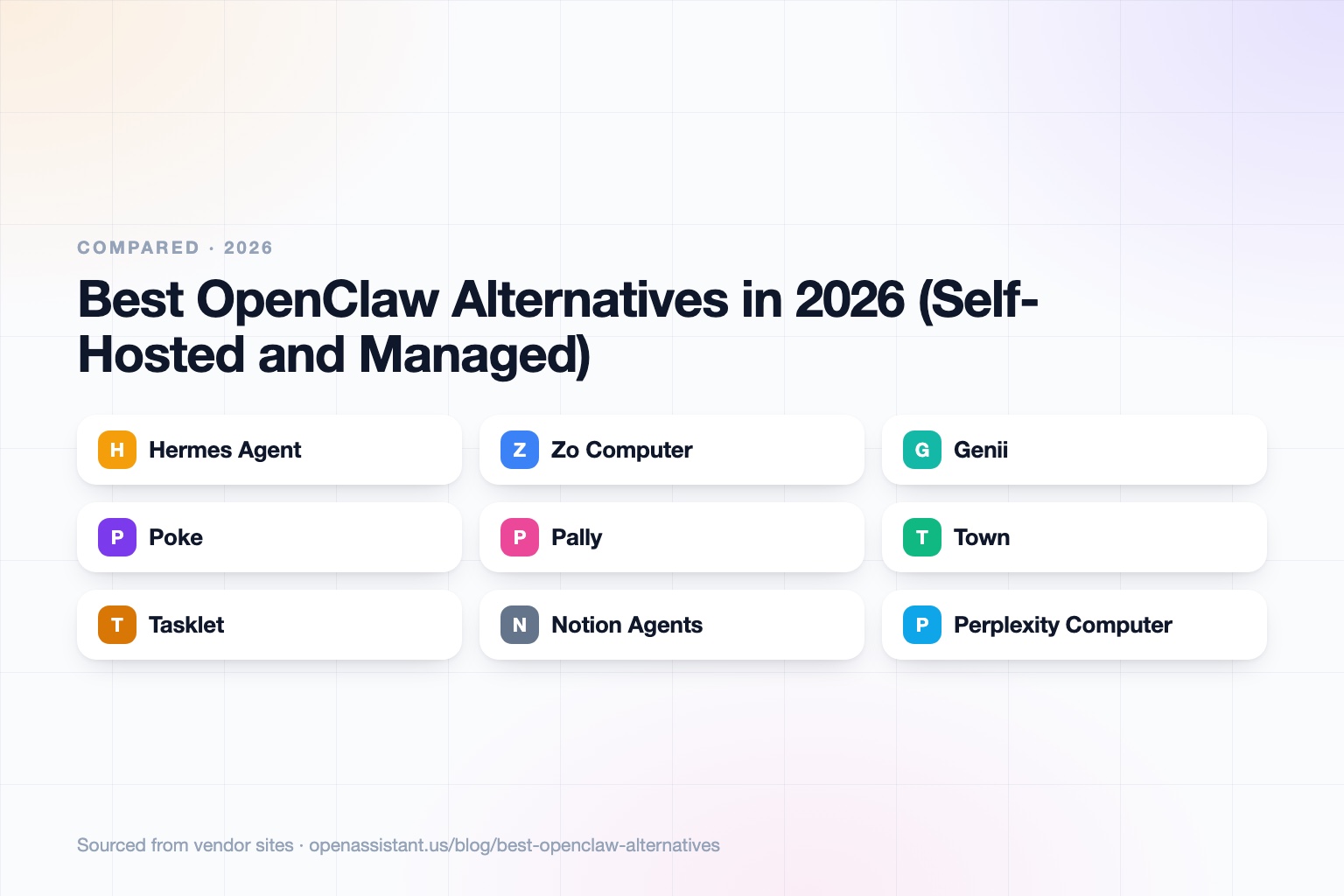
The short answer
The best OpenClaw alternative depends on why you are leaving. If you want to keep self-hosting but want a different security posture, look at Hermes Agent or Zo Computer. If you want someone else to run and secure it, look at a managed assistant.
- Best self-hosted alternative: Hermes Agent, which is also free and MIT-licensed, writes its own skills, and does not center on a public skill marketplace.
- Best always-on cloud computer: Zo Computer, if you want an agent that lives on a hosted computer without you managing a server.
- Best managed for individuals: Poke or Pally for a text-message assistant, with the caveat that Poke was acquired by Cognition and its plans after 2026 are not settled.
- Best managed for professionals and small teams: Town, which gives each assistant its own @town.com email and SOC 2 Type II coverage.
- Best for team automation: Tasklet or Notion Agents.
- Best when other people are involved: OpenAssistant, which has its own phone number and email and can make and receive calls.
OpenClaw Alternatives at a Glance
| Tool | Type | Best for | Pricing |
|---|---|---|---|
| Hermes Agent | Self-hosted (cloud option) | Developers who want a self-improving agent | Free self-hosted; Nous Portal $20, $100 or $200 per month; Hermes Cloud from $0.29 per day while running (a DEV Community guide), inference billed separately |
| Zo Computer | Hosted always-on computer | Technical users who want an agent on a cloud machine | 14 day free trial; Basic $18, Pro $64, Ultra $200 per month |
| Genii | iMessage-based, built on an open-source agent | iPhone users who want a text-based personal agent | Not published |
| Poke | Managed, text-based | Individuals who want a simple assistant in iMessage or WhatsApp | Free; Pro $19 per month; Ultra $199 per month |
| Pally | Managed, text-based | Consumers and prosumers; Max tier adds a phone number and email | Free; Pro $25 per month; Max $100 per month |
| Town | Managed, per-user assistants | Professionals and teams who want email, calendar and routines | Free; Starter $15 billed monthly, Pro to Power Plus $49 to $199 billed annually |
| Tasklet | Managed agent platform | Teams automating work from email, CRM and calendar triggers | Usage based; a third-party report cites plans from $25 per month |
| Notion Agents | Managed, inside Notion | Teams already living in Notion | Custom Agents billed in credits, $10 per 1,000 on Business and Enterprise (from May 4, 2026) |
| Perplexity Computer | Managed, cloud | Research and multi-step work across many models | Launched on Perplexity Max at $200 per month; later tiers not checked |
| OpenAssistant | Managed, with its own identity | Work that involves other people, inside and across companies | Private beta; request access |
Details reflect each vendor's public site, press coverage, and a research pass on October 3, 2026. Several of these products are weeks or months old, and prices change often. Where a figure is unpublished or unconfirmed, we say so.
Why people look for an OpenClaw alternative
OpenClaw (formerly Clawdbot and Moltbot) is a free, MIT-licensed, open-source agent with about 30 channels, a large community, and a 2.0 release in August 2026. People leave it, or never start, for a few consistent reasons. Its security record is the biggest: a patched remote code execution flaw (CVE-2026-25253), reports of malicious ClawHub skills, broad permissions, prompt-injection exposure, and sandboxing that is off by default. The second is upkeep, because you run and patch it yourself. The third is that it is built for one operator, not for a team that needs support and accountability.
Which alternative fits depends on which of those you are fixing. We split the list into self-hosted options, for people who still want control, and managed ones, for people who would rather not run anything. For a direct comparison with its closest rival, see OpenClaw vs Hermes Agent.
Self-hosted and open-source alternatives
Hermes Agent is the closest like-for-like swap. It comes from Nous Research, is MIT-licensed, written in Python, and lists 31 channels in its docs, including Telegram, Discord, Slack, WhatsApp, Signal, SMS, email and Matrix. It stores memory in files plus searchable SQLite, schedules with built-in cron, and writes its own skill files after tasks, so it does not depend on a ClawHub-style marketplace. Nous Portal lists paid plans at $20, $100 and $200 per month, and Hermes Cloud starts from $0.29 per day while running, with inference billed separately. The gaps: a smaller ecosystem than OpenClaw, no published agent phone number or email, and you still own the operational burden if you self-host.
Genii, from Intelligent Internet, is an assistant that lives in iMessage and delegates long-running research to Zenith, the company's open-source agent. You enter your phone number, no app or account, and a new contact appears. It has persistent memory, proactive texting, an isolated cloud computer, voice, and consent gates for consequential actions. It can join group chats and connects to Gmail, Google Calendar, Slack, GitHub, Maps and Drive. It was introduced on July 29, 2026. The gaps: iPhone only for now, pricing is not published, we could not confirm that Genii itself is open source, and we found no stated policy on training data or on contacting third parties. It is unrelated to the customer-support product with a similar name from tolk.ai.
Zo Computer is closer to a hosted version of the OpenClaw idea. It is an always-on cloud computer with an AI agent you reach by text, which runs automations and sites, and it positions itself as "the original OpenClaw". It has been available since June 2025 with a 14 day free trial, then paid plans at $18 (Basic), $64 (Pro) and $200 (Ultra) per month on its pricing page. The gaps: it is aimed at technical and prosumer users more than business teams.
Managed alternatives for individuals
Poke is a text-based assistant in iMessage, SMS, WhatsApp and Telegram, with a free tier, Pro at $19 per month, and Ultra at $199 per month. It connects to 30+ services and runs proactive background automations. Important: Poke was acquired by Cognition (reported by TechCrunch on July 24, 2026). It is reported to operate independently through the end of 2026, with the two products experimenting with integration from 2027, so its long-term direction is not settled. It is built for individuals, not teams. Details are in our Poke acquisition explainer.
Pally is a Y Combinator-backed startup that raised a $5.2M seed. You text it on iMessage, WhatsApp, RCS, Telegram or Slack, and it connects to Gmail, Calendar, Notion and Linear. It is free, then $25 per month for Pro and $100 per month for Max, and the Max tier gets a dedicated phone number and email. Call minutes are included on every tier. The gaps: it is very new, and we have no independent reliability reviews yet.
These are consumer-leaning, which is fine for personal use. For work accounts, check what each says about training on your data and about team controls before connecting a company mailbox. See best AI assistants you can text for the wider category.
Managed alternatives for professionals and teams
Town gives each user a "Townie" that acts across email, calendar, Slack and docs, with its own @town.com email address. It raised a $55M Series A led by Andreessen Horowitz on June 3, 2026, and came out of beta in June. It lists SOC 2 Type II, AI training off by default, and approval before actions are taken, plus Team and Enterprise plans. Individual plans on its pricing page run from Free to $199 for Power Plus; Starter is billed monthly and higher tiers are billed annually. The gaps: credit-metered pricing is hard to predict, and its safety page says SSO/SAML and SCIM are not currently available. See our Town review.
Tasklet comes from the Shortwave founders and is a B2B agent platform with triggers on email, CRM and calendar, thousands of integrations plus any MCP server, browser access, and SOC 2. Pricing is usage based. It rewards teams who want to design automations, and it is less of a personal assistant.
Notion Agents includes a personal Notion Agent on demand and Custom Agents that run 24/7 for teams, with Custom Agents billed in credits at $10 per 1,000 on Business and Enterprise plans since May 4, 2026. It is the natural pick if your work already lives in Notion, and a poor fit if it does not.
Perplexity Computer is a cloud agent that orchestrates many models and subagents for research, files, decks and apps. It launched on February 27, 2026 on Perplexity Max at $200 per month, and TechCrunch quoted an executive saying the unit economics of flat subscription pricing are not entirely clear.
OpenAssistant: when other people are involved
We build OpenAssistant, so weigh this entry accordingly. It is an assistant with its own phone number, and an email address or one on your company domain, running on a secure computer. It can make and receive calls and works over iMessage, SMS, WhatsApp, email and the web. It supports shared tasks and workflows inside and across companies, which suits scheduling and follow-ups that involve other people. Team plans include SAML SSO, SCIM and RBAC, Enterprise adds audit logs, it holds SOC 2 Type II and aligns with GDPR and CCPA, and it does not train on customer data. See the product page and trust page.
The gaps: it is in private beta, so you request access, and it is not free software you can inspect and modify the way OpenClaw is.
How to choose
- You want control and are happy to maintain it: Hermes Agent, or stay on OpenClaw and harden it.
- You want a hosted machine but still like the open-agent style: Zo Computer.
- You want a personal assistant in your texts: Pally, Genii (iPhone), or Poke with the roadmap caveat.
- You want a work assistant with security documentation: Town, Tasklet, Notion Agents, or OpenAssistant, depending on whether you want a personal assistant, an automation platform, or a Notion-native agent.
For a longer treatment of the business case, read OpenClaw alternative for business.
Frequently asked questions
What are the best OpenClaw alternatives?
For self-hosting, Hermes Agent, Zo Computer and Genii. For managed options, Poke, Pally, Town, Tasklet, Notion Agents, Perplexity Computer and OpenAssistant. The right one depends on whether you want control or convenience.
What is the best OpenClaw alternative?
Hermes Agent is the closest equivalent because it is also free, MIT-licensed and self-hostable, and does not center on a public skill marketplace. For a managed option with no server to run, Town and OpenAssistant target professionals.
Is there a safer alternative to OpenClaw?
Managed products with published compliance, such as Town (SOC 2 Type II) and OpenAssistant (SOC 2 Type II), shift the security burden to a vendor. Hermes Agent does not center on a ClawHub-style marketplace but is still self-managed.
Is Poke still a good OpenClaw alternative?
It works today, but Cognition acquired it in July 2026, and it is reported to operate independently through the end of 2026. Its direction after that is not settled.
Is Clawdbot the same as OpenClaw?
Yes. Clawdbot and Moltbot were earlier names of OpenClaw (it became OpenClaw on January 30, 2026), so alternatives to Clawdbot are alternatives to OpenClaw.
Do any OpenClaw alternatives give the agent its own phone number?
Pally's Max tier and OpenAssistant do. Town gives each assistant its own email address. OpenClaw and Hermes Agent do not publish a first-party number.
Sources
- Wikipedia: OpenClaw
- Composio: OpenClaw vs Hermes Agent
- Intelligent Internet: Genii
- Zo Computer
- Zo Computer pricing
- Nous Portal pricing
- Town safety page
- Poke
- TechCrunch: Why Cognition bought Poke
- Pally
- Town pricing
- Town Series A
- Tasklet
- Notion Agents
- TechCrunch: Perplexity's Computer
Facts last verified 2026-10-03.
More comparisons
If your work involves other people
OpenAssistant is our executive assistant for teams, with its own phone number and email. See how it compares:
Keep reading
Guides
- Best AI Executive Assistants in 2026 (Compared)
- Best AI Assistants You Can Text (iMessage, WhatsApp, SMS) in 2026
- Best AI Assistants That Make Phone Calls for You (2026)
- How to Use AI as an Executive Assistant (Step by Step)
- How to Know If an AI Tool Is Safe to Use in 2026
- How to Use AI at Work: 10 Practical Ways in 2026
- How Businesses Can Use AI Beyond ChatGPT in 2026
- 20 Tasks You Can Automate With AI at Work in 2026
- 9 Best AI Calendar Assistants for 2026
- 7 Best AI Email Assistants for 2026