Instinct vs. OpenAssistant: A Personal Assistant and a Work One
 Justin Canetti7 min read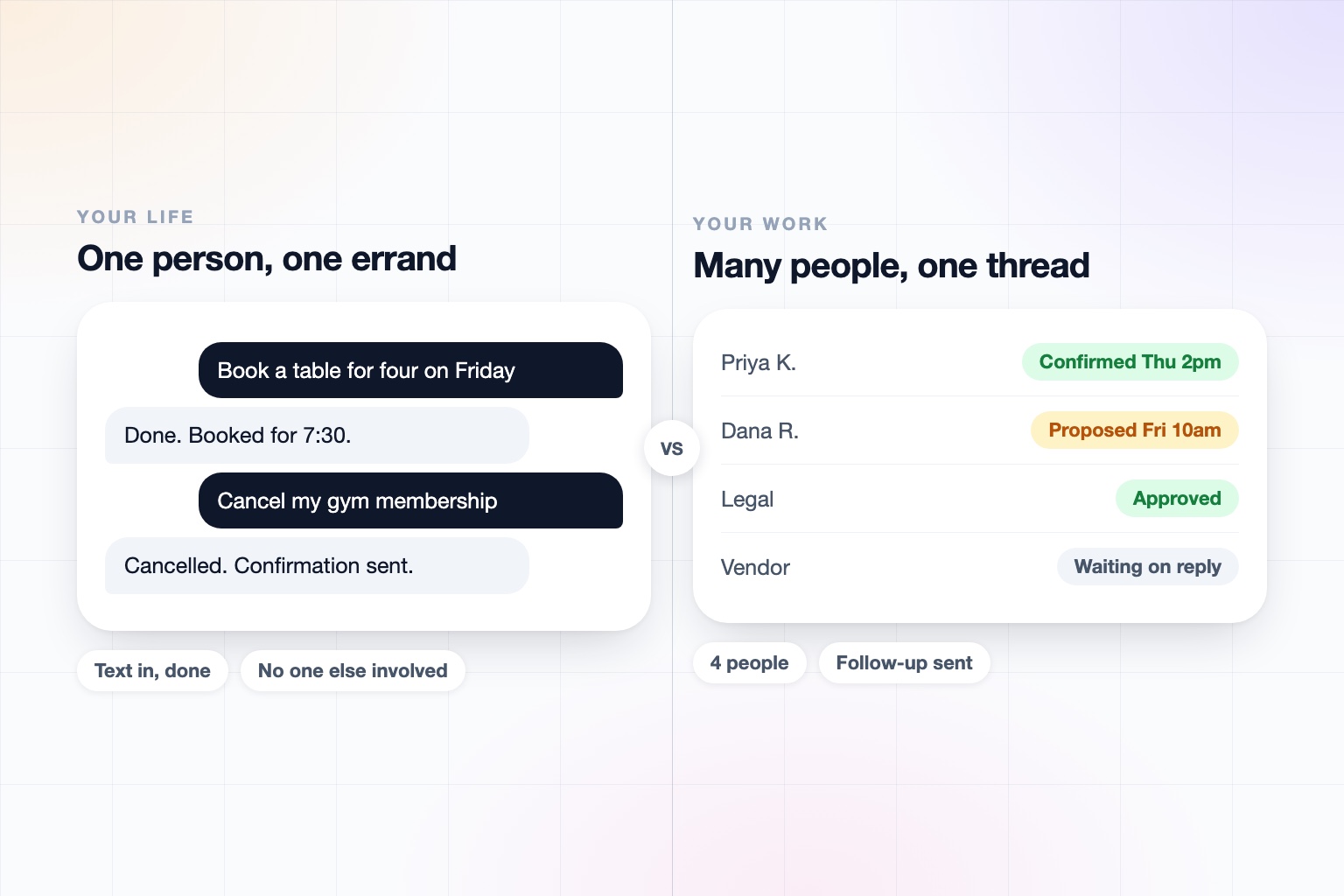
Instinct is one of the most talked-about AI products of the year, and it earned that. Founded in 2025, it went from a private beta to a reported $10 billion valuation in about a month, on the strength of an idea that people immediately understand: text an assistant, and it handles the errand.
It follows up on dropped threads, arranges rides, books services, and works from its own phone number and computer. If you have ever wished someone would just deal with your subscriptions, your trip, or your wedding logistics, you can see the appeal.
But there are two different jobs an AI assistant can do. One is running your life. The other is running your work, and work is mostly other people.
Instinct is built for the first. OpenAssistant is built for the second.
Instinct vs. OpenAssistant at a Glance
| Instinct | OpenAssistant | |
|---|---|---|
| Built for | Individuals: trips, bookings, groceries, tickets, subscriptions, life admin | Professionals and teams: work that involves colleagues, clients, and vendors |
| How you reach it | Text and phone calls; web settings | Phone calls, iMessage, SMS, WhatsApp, email, and web |
| Its own phone number, computer, and email | Yes, per press coverage; email addresses launched September 2026 | Yes, plus its own email address (or one on your company domain) |
| Coordinating with people who aren't users | Calls and emails on your behalf; a trusted-person network links your agent to friends' agents | Handles the whole exchange, including multi-person threads, hand-offs, and follow-ups |
| Shared tasks, files, and workflows | Single-user; we found no team or shared-task features | Shared tasks, memories, contacts, files, and workflows, inside your company and across companies |
| Recurring and triggered work | Proactive nudges; no documented workflow builder | Describe a workflow in plain English; run it on demand, on a schedule, or on a trigger |
| Data and training | Training on your inputs is on by default; opt-out in settings | No training on customer data |
| Security and admin | No SOC 2, SSO, or admin controls found on its site | SOC 2 Type II, GDPR and CCPA, SAML SSO, SCIM, and RBAC on Team plans, audit logs on Enterprise |
| Availability | Invite-only private beta; pricing not published | Private beta; request access |
Instinct details reflect its public site, terms of service, and press coverage as of September 2026. Instinct is in an invite-only private beta and changes quickly, so re-check before relying on any single row.
Instinct is an assistant for the errands in your life. OpenAssistant is an executive assistant for the work you do with other people.
Your Life Is a Party of One. Your Work Is Not.
Most personal-life errands are a solo transaction. You want a table for four, a cheaper flight, a canceled gym membership. The assistant acts, the world responds, and the only person who has to agree is you.
Work is different. Real work is not done alone at a desk, one on one with an agent. Business is about collaborating with other people, and that is where a personal assistant starts to strain. A renewal needs your vendor, your legal team, and your CFO to move in order. A hiring loop needs five calendars to line up. A launch needs someone to chase the three people who have not replied.
That kind of work leans on things a personal assistant has little reason to build:
- Multi-person coordination, where more than one human is on the thread and the assistant keeps track of who owes what
- Back-and-forth communication that runs for days without you re-explaining it
- Hand-offs and approvals, so the right person signs off before anything goes out
- Negotiation and consensus-building, like finding a time that works for six people
- Follow-ups and accountability, including nudging someone politely for the third time
- Social etiquette and reading the room, because a message to a client is not a message to a plumber
OpenAssistant is designed around those six.
A Coworker, Not a Feature of Your Phone
An OpenAssistant assistant is a named executive assistant with its own personality, its own phone number, its own email address (or one on your company's domain), its own secure computer, and access to your calendar. People can call it, text it, or email it, and it can reach out to them.
The people it deals with do not need an OpenAssistant account. And because it is a coworker rather than a personal app, it can be shared: tasks, memories, contacts, files, and workflows can live inside your company, or across companies, where your assistant works with someone else's on one shared task.
You also decide how human it seems. How an assistant presents itself, disclosure included, is a setting you control.
Workflows That Outlast the Conversation
Instinct is proactive in the moments that matter to a person: a flight check-in, a forgotten reservation. Work has a different rhythm. It repeats.
In OpenAssistant you describe a multi-tool workflow in plain English and it runs on demand, on a schedule, or when something happens: look up a lead in your CRM, update a spreadsheet, enrich it, brief you before the call, and update the CRM afterward. You say it once, and it keeps happening.
Trust, Data, and Governance
This is where a personal product and a business one diverge most.
Instinct's terms provide for training on your inputs by default, with an opt-out in settings, and we did not find SOC 2, SSO, or administrative controls on its site. For one person managing their own errands, that may be a fair trade for what the product delivers. For a company whose inboxes hold customer and employee data, it is usually not.
OpenAssistant is built for the second case:
- SOC 2 Type II, GDPR, and CCPA, with encryption in transit and at rest
- No training on customer data
- SAML SSO, SCIM, and RBAC on Team plans, and audit logs on Enterprise
- Per-action autonomy that an admin can lock team-wide, and supervision that can be tightened but never loosened by any instruction an assistant receives
- Credential hand-off so the assistant never sees your passwords
Details are on our Trust Center.
Who Should Use Instinct?
If what you want is a private concierge for your own life, and you are comfortable with a young product in invite-only beta, Instinct is a strong answer. It is proactive, it acts in the real world, and it is refreshingly easy to start: you text it. Its idea of agents that coordinate with your friends' agents is genuinely novel.
If you are booking a trip, planning a wedding, or trying to get rid of subscriptions, it is aimed squarely at you.
Who Should Use OpenAssistant?
OpenAssistant makes more sense if your reaction to Instinct was:
This is great for my weekend. I need it for my Monday.
It is for people whose day is made of other people, and for companies that want to give every employee a capable assistant without a security review that ends in a no. And the two are not mutually exclusive. Plenty of people will want a concierge for their personal life and an executive assistant for their work.
An executive assistant for the work you do with others
Connect your tools, hand over the recurring work, and let your assistant coordinate with the people around you.
Keep reading
Head-to-head comparisons
Guides
- Best AI Executive Assistants in 2026 (Compared)
- Best AI Assistants You Can Text (iMessage, WhatsApp, SMS) in 2026
- Best AI Assistants That Make Phone Calls for You (2026)
- How to Use AI as an Executive Assistant (Step by Step)
- How to Know If an AI Tool Is Safe to Use in 2026
- How to Use AI at Work: 10 Practical Ways in 2026
- How Businesses Can Use AI Beyond ChatGPT in 2026
- 20 Tasks You Can Automate With AI at Work in 2026
- 9 Best AI Calendar Assistants for 2026
- 7 Best AI Email Assistants for 2026