Instinct vs Meta Muse (2026): Which AI Personal Agent Is Better?
 Justin Canetti8 min read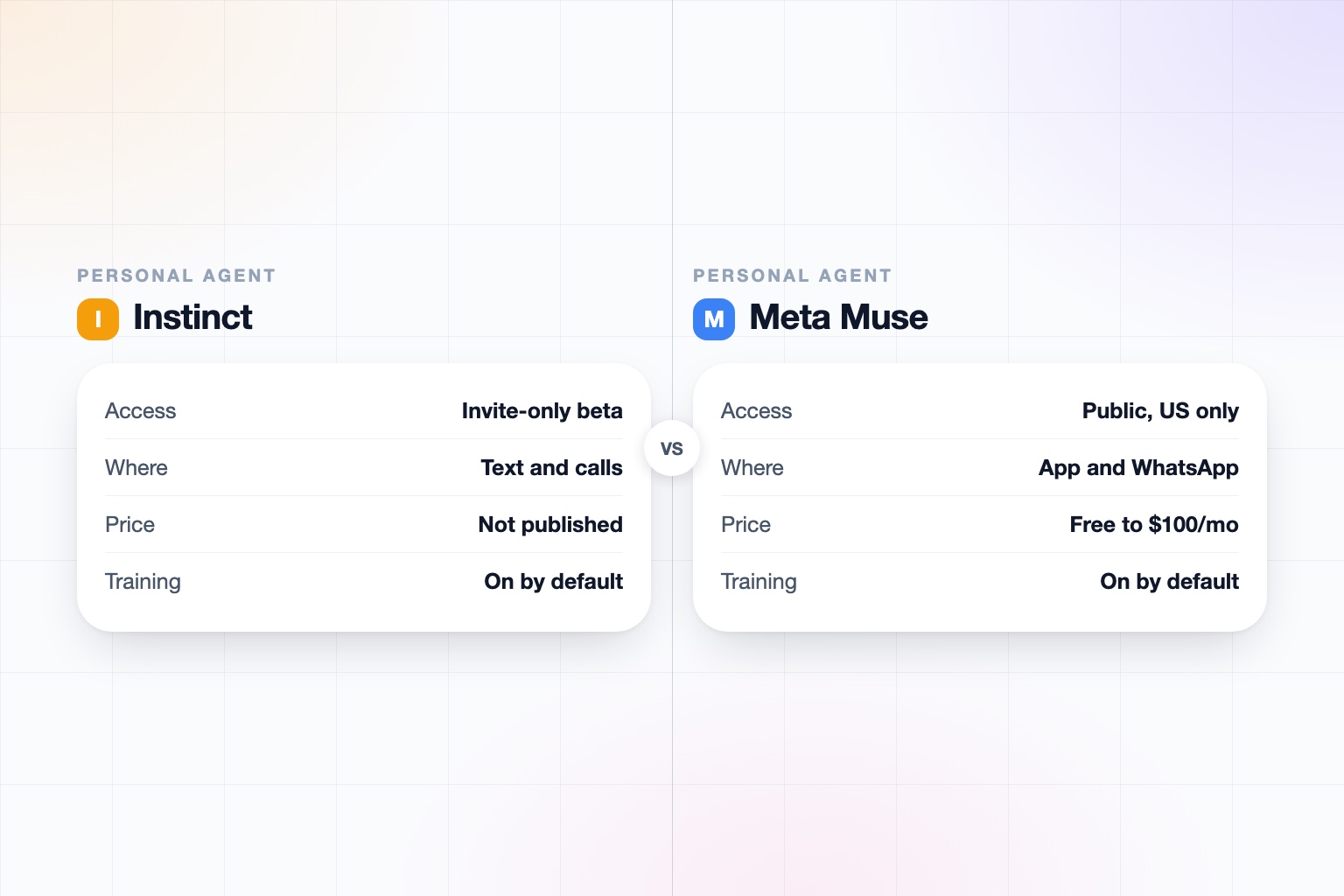
The short answer
Meta Muse is the easier one to actually get and try today; Instinct is the one to join a waitlist for if you want a text-and-phone-call assistant that finishes errands end to end. Both are personal agents for one person, and both are young, so the right pick depends mostly on access and how you like to interact.
- Pick Meta Muse if you are in the US, want to start right now, like a free tier with paid upgrades, or already live in WhatsApp and want an agent with a broad set of connectors and retail partners.
- Pick Instinct if you can get an invite, prefer to just text an assistant (no app), and want one that makes phone calls and follows up on its own.
Neither is documented as a team or work tool. If your goal is delegating work that involves colleagues and clients, see the last section and our guide to AI beyond ChatGPT for business.
Instinct vs. Meta Muse at a Glance
| Instinct | Meta Muse | |
|---|---|---|
| What it is | Personal AI assistant from Spear Street Technology, founded 2025 | Meta's consumer personal AI agent, launched September 8, 2026 |
| Who it is for | Individuals handling life admin and errands | Individual consumers; one owner per agent |
| Availability | Invite-only private beta, compute-limited; waitlist or invite from a member | US only at launch; open sign-up with a card required to start |
| Where you use it | Text messages (iMessage, WhatsApp per secondary sources) and phone calls; web settings; no mobile app yet | muse.ai, iOS, Android, and chats inside WhatsApp |
| Its own identity | Its own phone number and computer per TechCrunch, and its own email address since September 2026 per press coverage | Runs in a Muse Secure VM with its own browser; its own email address announced as coming soon |
| What it can do for you | Follows up on threads, arranges rides, books services and trips, cancels subscriptions, handles groceries and tickets | Sends email, books travel, fills forms, browses, negotiates, and pays via Link by Stripe |
| Contacting outside people | Phone-call concierge feature; sends emails on your behalf | Sends email and negotiates; we did not find confirmed outbound phone calls |
| Multi-person or team support | Trusted person network links your agent to friends' agents; no team or shared tasks found | One owner per agent; no group support found |
| Workflows and automation | Proactive nudges, such as flight check-in; no workflow builder documented | Background runs, custom API connections, browser fallback; no workflow builder documented |
| Payments | Stripe Link one-time cards with approval by amount, per secondary sources | Link by Stripe; PayPal named at Connect; Meta may later take a small transaction fee |
| Privacy and training | Training on inputs by default, opt-out in app settings; Vault content exempt | Training on interactions by default, opt-out in Settings, Data controls; not shared with Meta ad systems |
| Security and compliance | No SOC 2, SSO, or admin controls found on its site | No SOC 2, ISO, HIPAA, or GDPR certifications found |
| Pricing | None published; free during private beta, fees may come later | Free tier with usage meter, Power $20 per month, Maximum $100 per month |
Details reflect public sites, help pages, and press coverage as of September 2026. Both products change quickly, so re-check before relying on any single row.
What is Instinct?
Instinct is a personal AI assistant built by Spear Street Technology in San Francisco. It was founded in 2025 by Noah Shinn, previously at Sierra, and opened an invite-only private beta around August 2026. TechCrunch reported a $250M Series B on August 26 and a $1B Series C at a $10B valuation on September 28. User counts and revenue are undisclosed.
The pitch is simple: you text it, and it handles things. It follows up on dropped threads, arranges rides, books services, trips, groceries and concert tickets, cancels subscriptions, and helps plan events like weddings. It is also proactive, meaning it can start a conversation when something needs action, such as a flight check-in or a forgotten reservation.
Per TechCrunch it works from its own phone number and computer, and it has a phone-call concierge feature. There is no mobile app yet; you text to get started and use app.instinct.com for settings.
What is Meta Muse?
The name Muse covers three separate things at Meta: the Muse Spark models, the Meta Business Agent for WhatsApp Business, and Muse, the consumer personal agent that launched on September 8, 2026. This post is about the last one.
Muse runs in the background in a Muse Secure VM with its own browser. It can send email, book travel, fill forms, browse, negotiate, and pay through Link by Stripe. Its connectors cover email, calendar, payments, health, smart home, dining, shopping, music and events, and it has named partners such as Stripe, Shopify, Expedia and Instacart. You can name it and pick its avatar and style.
At Connect on September 23, Meta announced more to come: a wake word on AI glasses, live video chat with a Realtime Avatar, Mac desktop control, and an email address for Muse itself. Those are announcements, not features you can use today.
Is Instinct free? Is Meta Muse free? Access and pricing
Instinct is free during its private beta, but you need to get in. It is invite-only and compute-limited, so access comes from the waitlist or from a member. There is no published price list. Its terms say fees may be required later; we are not repeating any rumored tiers because we could not verify them.
Meta Muse has a free tier, and you can start now if you are in the US. TechCrunch reported a free tier with a usage meter, a Power plan at $20 per month, and a Maximum plan at $100 per month. A card is required to start, and Meta may later take a small transaction fee on purchases.
The practical difference: with Muse you know what the ceiling costs. With Instinct you get free access, if you get access at all, and no idea what it will cost after beta. For a broader look at the category, see our roundup of the best AI personal assistants in 2026 and the pricing page for ours.
Head to head: what each can actually do
Both are agents that take real actions, not chatbots that suggest what you could do. Beyond that, their strengths differ.
- Instinct's edge is finishing errands end to end, including phone calls, and being proactive. Its trusted person network, where your agent coordinates with friends' agents you authorize, is a genuinely novel idea.
- Muse's edge is breadth. Payments, a large retail and travel partner list, a browser fallback for sites with no connector, custom API connections, and more than 1,500 developer connector applications in under a week give it a wide action surface.
- Instinct's gap: it appears to be single-user, with no documented group, team, or shared-task features, and no documented workflow builder.
- Muse's gap: one owner per agent, no group support found, and we did not find confirmed outbound phone calls. Some blogs claim it can call businesses; we could not verify that.
If your day is mostly emails, forms, bookings and shopping, Muse's reach is hard to beat. If it is mostly things that go faster with a phone call or a text nudge, Instinct's design fits better. For ideas on what to hand off, see tasks to automate with AI.
Does Instinct or Muse train on your data? Privacy compared
Both train on your inputs by default, and both let you opt out. Instinct's terms (updated August 26, 2026) say training on inputs is on unless you opt out at app.instinct.com/settings, with Vault content exempt. Meta's help center says Muse trains on interactions, including messages, tool calls and agent hand-offs, unless you opt out under Settings, Data controls.
Meta documents more of its safety design. Names, emails, phone numbers and SSNs are stripped before training, data is not shared with Meta ad systems, passwords and payment details are kept from the model in a Secure Credentials Store, and permission checks for emails and purchases are enforced outside the model. A Confidential VM with a user-held key is promised but not shipped.
Instinct's terms require users to be 18 or older, cap liability at $100 or six months of fees, and require arbitration. TechCrunch noted privacy criticism over overly generous permissions. Neither company lists SOC 2, SSO or admin controls that we could find, so neither is a fit for regulated workplaces today. Our guide on how to know if an AI tool is safe covers what to check, and our trust page shows how we approach it.
Head to head: identity and channels
Instinct lives in your messages. You text it, it texts back, and it can call. No app to install is a real advantage for people who do not want another icon.
Muse lives in more places: a web app, iOS and Android apps, and WhatsApp chats. It does not yet have its own email address, though Meta says one is coming soon.
On identity, Instinct uses its own phone number and computer, per TechCrunch. Muse runs in its own secure VM with its own browser. Whether an outside person sees a clear label when either one contacts them is not something we found documented for either product.
Who each is best for
- Instinct suits people who value a hands-off, text-first assistant, can get an invite, and are comfortable with training on by default and broad permissions during a beta.
- Muse suits US users who want to start today, want a free tier they can grow out of, and use WhatsApp or want broad shopping and travel integrations.
- Neither is documented for teams, shared tasks, or workplace compliance. For that, see our guides on how to use AI at work and AI email assistants, and look at the alternatives for work.
Also worth reading: how Muse stacks up against other new agents in Muse vs. Cue by Manus and Muse vs. Grok Bot.
How they differ in one line
Instinct is a text-and-call assistant that runs errands for you if you can get in; Meta Muse is an open-to-try, broader-reach agent with a free tier and a clearer published safety design, but no phone-call feature we could confirm.
Frequently asked questions
Is Instinct better than Meta Muse?
Neither is better across the board. Muse is easier to access and has more documented safety design and price clarity; Instinct is text-first, proactive, and has a phone-call concierge, but is invite-only.
Is Instinct free?
It is free during the private beta, but access is by waitlist or invite. There is no published pricing, and its terms say fees may be required later.
How much does Meta Muse cost?
TechCrunch reported a free tier with a usage meter, Power at $20 per month and Maximum at $100 per month. A card is required to start, and Meta may later charge a small transaction fee.
Does Muse or Instinct train on my data?
Both use your inputs for training by default. Instinct offers an opt-out at app.instinct.com/settings, and Muse offers one under Settings, Data controls.
Does Instinct have its own phone number?
TechCrunch reports it uses its own phone number and computer. TechCrunch also reported on September 9 that Instinct launched its own email addresses for users.
Can I use Muse outside the US?
At launch it is US only. We did not find a confirmed date for other countries.
Sources
- Instinct terms of service
- TechCrunch: Instinct raises $1B Series C (Sep 28, 2026)
- Meta: Introducing Muse
- Meta help center: Muse and your data
Facts last verified 2026-10-01.
More comparisons
- Grok Bot Pricing (2026): What It Costs and Which Plan You Need
- Meta Muse vs Claude Cowork (2026): Which AI Agent Is Better?
- Best AI Personal Assistants and Agents in 2026, Compared
- Muse vs Manus Cue (2026): Which AI Agent Should You Pick?
- Meta Muse vs Grok Bot (2026): Which AI Agent Is Better?
- Instinct vs Cue by Manus (2026): Which AI Agent Wins?
- Instinct vs Grok Bot (2026): Which AI Agent Is Better?
If your work involves other people
OpenAssistant is our executive assistant for teams, with its own phone number and email. See how it compares:
Keep reading
Guides
- Best AI Executive Assistants in 2026 (Compared)
- Best AI Assistants You Can Text (iMessage, WhatsApp, SMS) in 2026
- Best AI Assistants That Make Phone Calls for You (2026)
- How to Use AI as an Executive Assistant (Step by Step)
- How to Know If an AI Tool Is Safe to Use in 2026
- How to Use AI at Work: 10 Practical Ways in 2026
- How Businesses Can Use AI Beyond ChatGPT in 2026
- 20 Tasks You Can Automate With AI at Work in 2026
- 9 Best AI Calendar Assistants for 2026
- 7 Best AI Email Assistants for 2026