Claude Cowork vs. OpenAssistant: Which Works With Your Team?
 Justin Canetti8 min read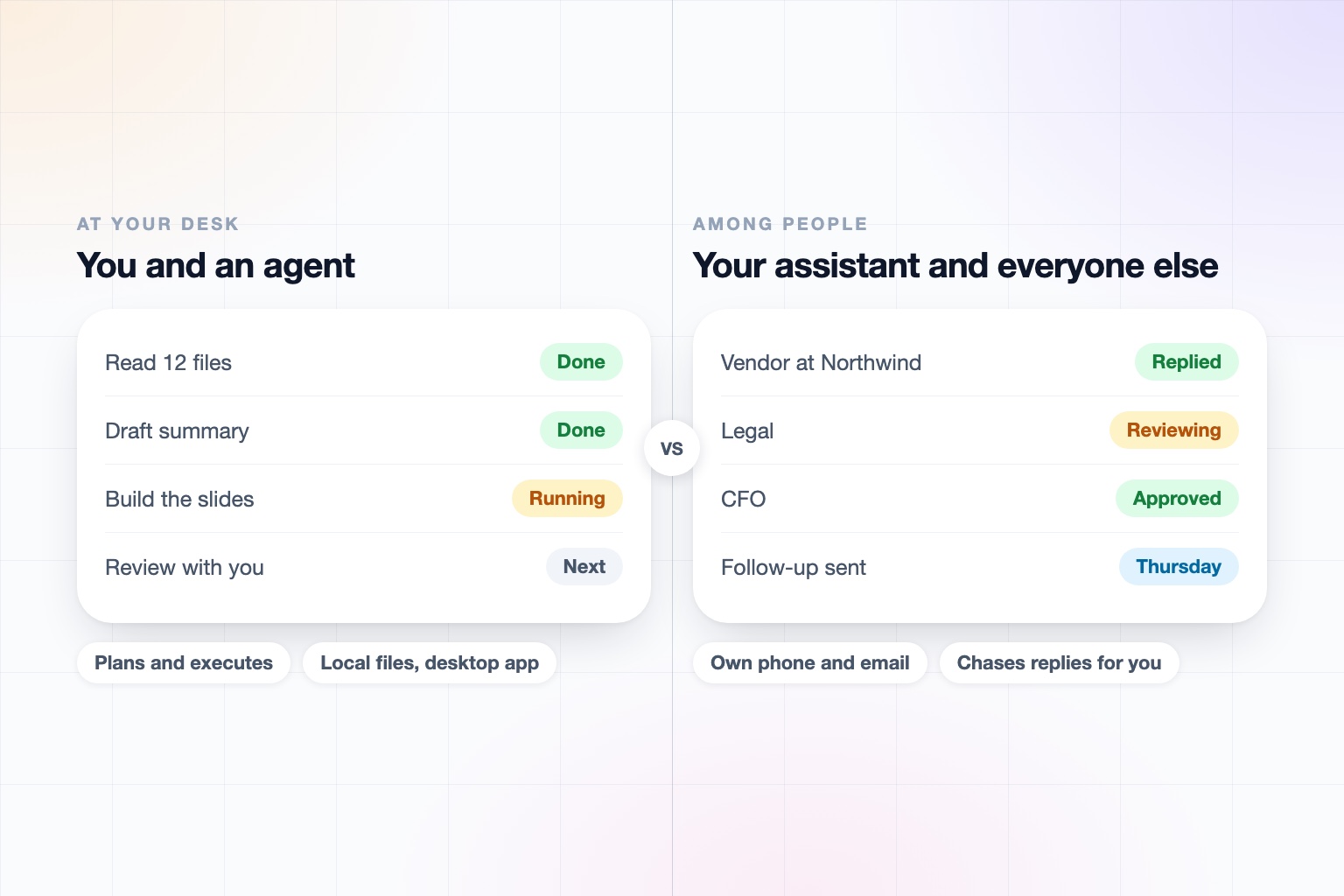
Claude is one of the best AI models available, and Cowork is how Anthropic brings it to knowledge work beyond code. You give it a goal. It makes a plan, splits the work into parallel subtasks, runs code and shell commands, works with files and connected apps, and shows you each step.
It is a strong product from a company with a deserved reputation for careful engineering, and it has grown quickly: scheduled tasks in February, general availability in April, web and mobile in July, and, most recently, Cowork in every conversation.
We use the word cowork differently, though. In Claude Cowork, you and Claude work together, at a desk, on a task. In OpenAssistant, your assistant is a coworker in the sense that a colleague is: it has a name, a phone number, an inbox, and it works with other people on your behalf.
Claude Cowork vs. OpenAssistant at a Glance
| Claude (Cowork) | OpenAssistant | |
|---|---|---|
| What it is | An agentic mode of Claude for knowledge work: you give a goal, it plans and executes with your files and apps | An executive assistant with its own identity that handles work involving other people |
| Where it runs | Desktop app, web, mobile, and a Chrome extension; local files and computer control need the desktop app | Its own secure computer in the cloud; you reach it by phone, iMessage, SMS, WhatsApp, email, or web |
| Its own phone number and email | None found; it acts as you through connectors | Yes: its own name, phone number, and email address (or one on your company domain) |
| Contacting people outside your company | Not documented as an autonomous capability | Handles the exchange itself, including multi-person threads, hand-offs, and follow-ups |
| Shared work | Sessions are individual; artifacts can be shared. Claude Tag (beta) is a shared agent in team chat channels | Shared tasks, memories, contacts, files, and workflows, inside your company and across companies |
| Scheduled and triggered work | Scheduled tasks (hourly to weekly) in the cloud; no event triggers found for Cowork | Workflows on demand, on a schedule, or on a trigger, described in plain English |
| Connectors | Microsoft 365, Google Drive, and more, plus plugins, skills, and MCP servers | Your calendar, inbox, files, and business systems |
| Security and admin | SOC 2, ISO 27001, and ISO 42001; SSO, SCIM, RBAC, audit logs, and a Compliance API on Enterprise | SOC 2 Type II, GDPR and CCPA, SAML SSO, SCIM, and RBAC on Team plans, audit logs on Enterprise |
| Pricing | Pro $20/month, Team from $20 per seat, Max from $100/month, Enterprise on request | Paid plans per seat; request access |
Claude details reflect Anthropic's product pages, support articles, and release notes as of September 2026. Claude ships new features frequently, and some, including shared agents in team chat and sharing of Cowork work, are still changing, so re-check before relying on any single row.
Claude Cowork is an agent you work alongside. OpenAssistant is an executive assistant that works with other people for you.
What Claude Cowork Does Well
If the job is a well-defined piece of knowledge work, Cowork is excellent.
- Depth of execution. It plans, delegates to sub-agents, runs code, and produces real files, with each step visible.
- A frontier model. You get Claude's reasoning across whatever you point it at.
- Cloud scheduled tasks. Recurring work runs even when your laptop is closed.
- An ecosystem. Plugins, skills, MCP servers, and connectors let a team shape it.
- Governance. Enterprise plans include SSO, SCIM, RBAC, audit logs, and a Compliance API, on top of a strong certification list and a no-training-by-default policy for business plans.
For an analyst assembling a deck from a folder of documents, a lawyer reviewing a stack of contracts, or a developer, that is a great deal of capability. We would not tell them otherwise.
A Desk Task vs. a Conversation
Cowork is at its best when you are present, or at least when the work lives on your computer: your files, your folders, your apps. You direct it, review it, and steer it. Some of its most useful features, like local folder access and computer control, need the desktop app to be open.
Much of the work that eats a professional's week is not a task on a desk. It is a conversation among people. A renewal needs your vendor, your legal team, and your CFO to move in order. A hiring loop needs six calendars to line up. A launch needs someone to chase the three people who have not replied.
Real work is not done alone at a desk, one on one with an agent. Business is about collaborating with other people, and that takes a set of skills that a desk agent does not need:
- Multi-person coordination, holding the thread across many humans
- Back-and-forth communication that runs over days
- Hand-offs and approvals, so the right person signs off before anything goes out
- Negotiation and consensus-building, like finding a time that works for everyone
- Follow-ups and accountability, including nudging someone politely a third time
- Social etiquette and reading the room, because a message to a client is not a message to a teammate
That is what OpenAssistant is built for. You can email it, text it, or call it, and it can call, text, or email the people involved. They do not need an account, or a login, or to know anything about AI.
An Assistant With Its Own Identity
Cowork acts as you, through connectors and the apps on your machine. That is a sensible model for a tool that works alongside you.
An OpenAssistant assistant is a someone. It has its own name, personality, phone number, email address (or one on your company domain), and secure computer, and it manages your calendar. When it writes to your vendor, it is clear who is writing, and the vendor can reply to it directly. You control how human it seems, disclosure included.
That identity is also what lets it be shared. Tasks, memories, contacts, files, and workflows can live inside your company or across companies, where your assistant works with someone else's assistant on a single task.
From One Person to the Whole Company
Anthropic is clearly working on the team problem. Claude Tag, a beta agent that lives in team chat channels and remembers each channel's context, is a step toward shared, multiplayer agents. Cowork sessions themselves remain individual.
OpenAssistant is team-shaped from the start, with governance to match:
- SOC 2 Type II, GDPR, and CCPA, with encryption in transit and at rest, and no training on customer data
- SAML SSO, SCIM, and RBAC on Team plans, and audit logs on Enterprise
- Per-action autonomy an admin can lock team-wide, with supervision that can be tightened but never loosened by any instruction the assistant receives
- Credential hand-off, so the assistant never sees your passwords
Details are on our Trust Center and pricing page.
They Are Not Mutually Exclusive
This is not a choice you have to make. A team can have Cowork for the analysis, documents, and code that live on a desk, and OpenAssistant for the scheduling, follow-up, coordination, and recurring workflows that live among people.
Use Claude Cowork if you want a powerful agent working alongside you on tasks that run through your files and apps.
Use OpenAssistant if your reaction to Cowork was:
Great for the work I do at my desk. Who handles the work that runs through other people?
An executive assistant for the work you do with others
Connect your tools, hand over the recurring work, and let your assistant coordinate with the people around you.
Keep reading
Head-to-head comparisons
Guides
- Best AI Executive Assistants in 2026 (Compared)
- Best AI Assistants You Can Text (iMessage, WhatsApp, SMS) in 2026
- Best AI Assistants That Make Phone Calls for You (2026)
- How to Use AI as an Executive Assistant (Step by Step)
- How to Know If an AI Tool Is Safe to Use in 2026
- How to Use AI at Work: 10 Practical Ways in 2026
- How Businesses Can Use AI Beyond ChatGPT in 2026
- 20 Tasks You Can Automate With AI at Work in 2026
- 9 Best AI Calendar Assistants for 2026
- 7 Best AI Email Assistants for 2026