Cue by Manus vs Claude Cowork (2026): Which AI Agent Wins?
 Justin Canetti9 min read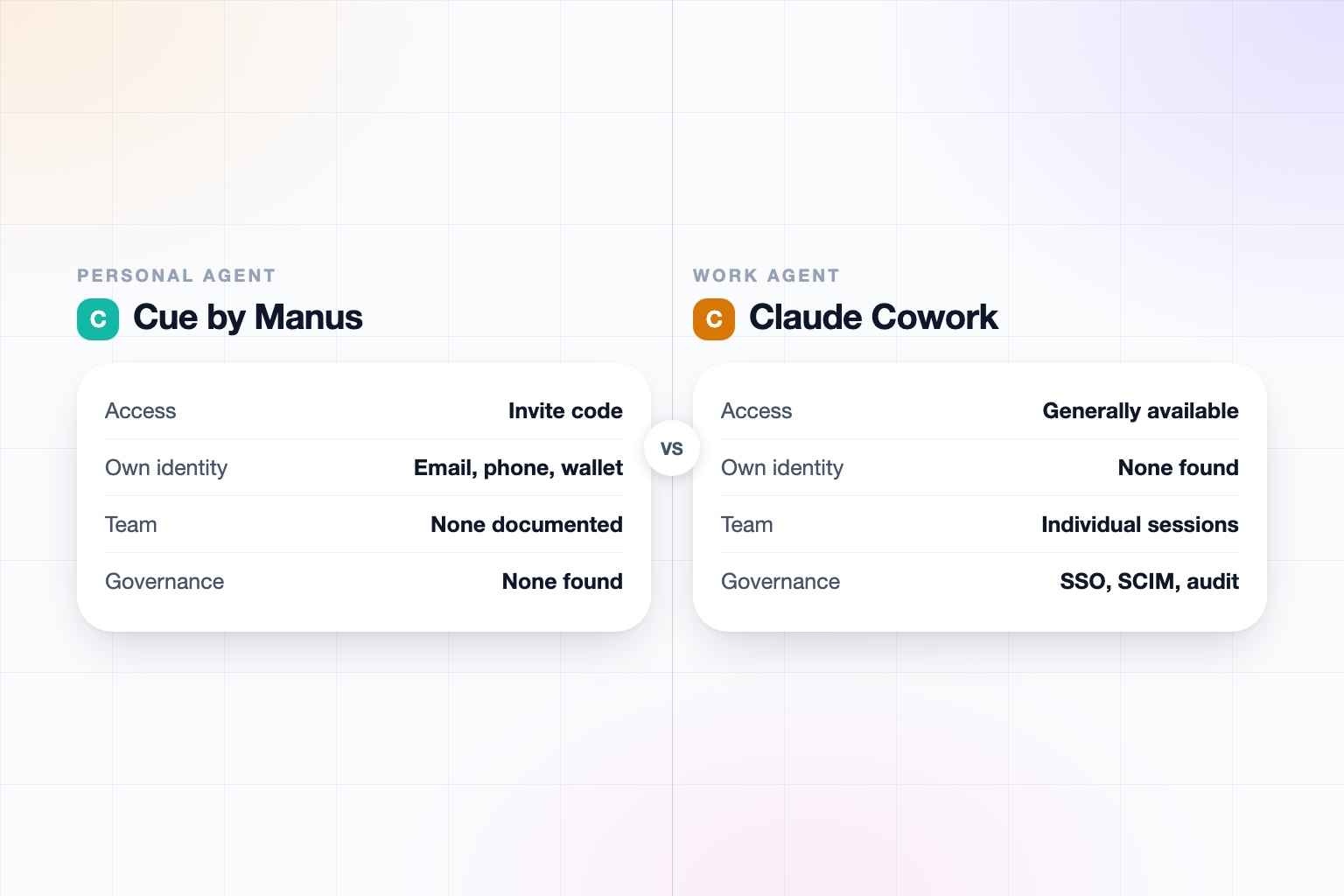
The short answer
These two solve different problems: Cue by Manus is an agent with its own identity and its own computer that works on your behalf, while Claude Cowork is a governed agent for knowledge work that acts as you through your connected accounts. Cue is newer and still in early access, and Cowork is generally available with deep admin controls.
Pick Cue by Manus if:
- You can get an invite code and want an agent with its own email address, phone number, wallet, and dedicated computer.
- You want several agents to share a group chat, split one job, and hand work to each other.
- You want event-triggered automations, such as starting a task when a new email arrives.
Pick Claude Cowork if:
- You need SSO, SCIM, RBAC, audit logs, and a compliance story your security team can review.
- You want a plan-and-execute agent on a published price list, with scheduled cloud tasks and a connector and plugin ecosystem.
- You work across desktop, web, and mobile and want local file access with the desktop app open.
If you are earlier in the decision, our guide to AI beyond ChatGPT for business covers the wider field.
Cue by Manus vs. Claude Cowork at a Glance
| Cue by Manus | Claude Cowork | |
|---|---|---|
| What it is | A standalone Manus app for personal agents, launched September 28, 2026 alongside Manus 2.0 | The agentic mode of Claude for non-coding knowledge work |
| Who it is for | Individuals who want an agent that works on its own machine | Knowledge workers in support, legal, sales, security, finance, healthcare, and government |
| Availability | Early access, invite code required; iOS awaiting App Store review | Generally available since April 2026 on Pro, Max, Team, and Enterprise; admins enable it |
| Where you use it | Web, desktop, and mobile apps | Desktop app (macOS, Windows), web, mobile, and a Chrome extension side panel |
| Its own identity | Each agent has its own email address, phone number, wallet, and dedicated computer | None found; acts as the user through connectors |
| Where the work runs | A dedicated Cloud Computer that keeps jobs running when your device is closed; its pricing is undisclosed | Cloud sessions in an isolated environment; local files, browser use, and computer control need the desktop app open |
| Payments | Makes payments inside a user-set budget | Not documented |
| Multiple agents | Agents share a group chat, split parts of a job, and delegate to each other | Parallel subtasks inside a session; Claude Tag (beta, Slack) gives one Claude per channel |
| Automation | Event triggers (new email, calendar event, Notion update, Slack message) and scheduled tasks that become Automations | Scheduled tasks (hourly, daily, weekly, weekdays) in the cloud; no event or webhook triggers found for Cowork |
| Integrations | Gmail, Dropbox, GitHub, Notion, calendar; full list and MCP unverified | Microsoft 365, Google Drive, Slack, Amplitude, plus plugins, skills, and MCP servers |
| Pricing | Free during early access; later pricing not disclosed | Free $0; Pro $17 annual or $20 monthly; Max from $100; Team $20 annual or $25 monthly; Enterprise $20/seat plus usage |
| Security and compliance | No SOC 2, admin, or audit information found; a user-set spending budget is documented | SOC 2 Type I and II, ISO 27001:2022, ISO 42001, HIPAA-ready with BAA; SSO, SCIM, RBAC, audit logs on Enterprise |
Based on Manus's Manus 2.0 announcement, Anthropic's pricing page and release notes, and press coverage as of September 2026. Both products change quickly, so re-check before relying on any single row.
What Is Cue by Manus?
Cue is a standalone Manus app for personal agents. It launched on September 28, 2026, alongside Manus 2.0. The central idea is that each agent is a separate entity: it has its own email address, its own phone number, its own wallet, and a dedicated computer. That computer, called Cloud Computer, keeps jobs running when your own device is closed. Manus has not disclosed what Cloud Computer will cost.
Cue completes tasks on its own machine, sends messages, and makes payments inside a budget you set. It can answer incoming calls and leave a summary in the app, and it can scan QR codes for things like restaurant ordering or holding a place in line. Web, desktop, and mobile apps exist, with iOS awaiting App Store review.
There is also an ownership footnote worth knowing. Meta announced it would acquire Manus in December 2025, China blocked the deal in April 2026, and Manus said in August 2026 that it would return to operating independently. Cue launched after that split and is not a Meta product, though Computerworld framed it as a rival to Meta's Muse.
What Is Claude Cowork?
Claude Cowork is Anthropic's agentic mode of Claude for non-coding knowledge work. You give it a goal. It plans, splits the work into parallel subtasks, runs code and shell commands, and shows each step so you can steer. Sessions run in the cloud in an isolated environment.
You can reach it from the desktop app on macOS and Windows, on the web at claude.ai, on mobile, and from a Chrome extension side panel. Local file access, browser use, and computer control need the desktop app open, and local folders are limited to ones you connect. With Dispatch, Pro and Max users can message Claude from a phone in one continuous thread and have it run on their desktop, provided the desktop is awake with the app open.
Its release history is short and quick: a plugin marketplace and admin controls in February 2026, scheduled tasks later that month, general availability on macOS and Windows in April with usage analytics and OpenTelemetry, web and mobile in July, and Cowork in every conversation in September.
Head to Head: Identity and the Computer It Works On
This is the clearest difference between the two products. Cue gives each agent an identity bundle: email, phone number, wallet, and its own computer. In practice that means the agent can be something you hand a job to and then check on, rather than a mode you switch on in your own session.
Claude Cowork acts as you. We did not find a Cowork-owned email address or phone number, and it works through your connected accounts and, with the desktop app open, your own files and browser. That is a simpler trust model, because everything it does is under your existing identity, but it also means there is no separate Cowork identity for outside parties to deal with.
A few things we could not confirm for Cue. We did not find documentation on outbound voice calls, on whether it needs your approval before it messages someone, or on how it identifies itself to outside people. We also did not find whether you can text or email your agent from your own iMessage, SMS, or email. For Cowork, we did not verify autonomous outreach to outside parties either.
Automation: Event Triggers vs Scheduled Tasks
Both products can work while you are away, in different ways.
- Cue: you can set a task to start on an event, such as a new email, a calendar event, a Notion update, or a Slack message, by describing it in a prompt. Scheduled tasks become Automations.
- Claude Cowork: scheduled tasks run hourly, daily, weekly, weekdays, or on demand, in the cloud even with your laptop closed, on all paid plans. Cloud tasks cannot use local folders. We did not find event or webhook triggers for Cowork.
If your work is reactive, where something arrives and the agent should respond, Cue's event triggers are the more documented fit. If your work is routine and calendar-driven, Cowork's scheduled tasks cover it with a clear set of cadences. For ideas on what to hand off first, see tasks to automate with AI.
Multiple Agents, Group Chats, and Sharing
Cue's multi-agent design is a genuine strength. Several agents can share a group chat, split parts of one job, and delegate to each other. Manus's example is a research agent, a shortlist agent, and a presentation agent working in sequence, with the user giving final approval. Multiple humans sharing one agent, team plans, and shared tasks between people are not documented.
Cowork handles parallelism inside a single session, where one goal is split into subtasks. Sessions themselves cannot be shared, only artifacts, though the page we read may predate the September update. For teams, Claude Tag in beta for Team and Enterprise puts one Claude in each Slack channel, serving everyone there. It remembers channel context, can schedule follow-ups, and lets admins scope identities, tools, data, and spend per channel, with activity logs and per-channel memory viewable.
In short, Cue coordinates several agents for one person, and Cowork with Tag is the more developed answer for a team sharing one agent.
Pricing and Access
Cue is free during early access, but you need an invite code. Manus has not said what it will cost afterward, and Cloud Computer pricing is also undisclosed. You are evaluating a product whose price you cannot yet know.
Claude Cowork has a published price list. Free is $0. Pro is $17 per month billed annually or $20 monthly. Max starts at $100 per month. Team standard seats are $20 per month billed annually or $25 monthly, and Premium seats are $100 annual or $125 monthly with 5x usage. Enterprise is $20 per seat per month plus usage at API rates. Cowork is available on paid plans, and admins on Team and Enterprise enable it.
For a wider market view, see our roundup of the best AI personal assistants in 2026 and the pricing page for ours.
Security, Compliance, and Admin Controls
Here the gap is large and the facts are one-sided. For Cowork, Anthropic lists SOC 2 Type I and II, ISO 27001:2022, ISO 42001, and a HIPAA-ready configuration with a BAA. Enterprise adds SSO, SCIM, RBAC, audit logs, a Compliance API, and custom retention, and Cowork has usage analytics and OpenTelemetry. Team and Enterprise data is not used for training by default, while Free, Pro, and Max show an opt-out.
For Cue, we did not find SOC 2, admin, or audit information. The only control documented is a spending budget you set for payments. That does not mean controls are absent, only that we could not find them, and a new product in early access often lacks published documentation. It does mean a security team has little to review today.
Give an agent with a wallet, a phone number, and its own computer the same scrutiny you would give a new hire with those things. Our guide on how to know if an AI tool is safe lists what to check, and our trust page shows how we approach it.
Who Each Is Best For
- An individual who wants a delegate: Cue, if you can get in. The separate identity and its own computer fit someone who wants to hand over errands and long jobs.
- A team with compliance needs: Cowork. Documented certifications, SSO, SCIM, RBAC, and audit logs are what a procurement review asks for.
- Someone building multi-step workflows across several specialists: Cue's group chats of cooperating agents are a good fit, and so are its event triggers.
- Someone who lives in documents, spreadsheets, and Slack: Cowork, with its connectors, plugins, and Claude Tag.
- A reader who wants a price before committing: Cowork. Cue has not published one.
Also worth reading is how Cue stacks up against other agents in Muse vs. Cue by Manus and Claude Cowork vs. ChatGPT, and the Claude Cowork alternative for work if you need an assistant that works with other people.
How They Differ in One Line
Cue by Manus is an agent with its own identity and computer that you invite into your life, and Claude Cowork is a governed agent that works as you inside your company's tools. Many people will reasonably try Cue personally while their employer standardizes on something with documented controls. For the work-focused view of Cue, see the Cue by Manus alternative for work.
Frequently asked questions
Is Cue by Manus better than Claude Cowork?
Neither is better across the board. Cue gives each agent its own email, phone number, wallet, and computer, while Cowork offers published pricing, deep admin controls, and compliance certifications.
Does Cue by Manus cost anything?
It is free during early access, and an invite code is required. Manus has not disclosed pricing after early access, or pricing for Cloud Computer.
Does Claude Cowork have its own email or phone number?
We did not find one. Cowork acts as the user through connected accounts, and autonomous outreach to outside parties is not verified.
Can Cue run tasks automatically?
Yes. You can set a task to start on an event such as a new email, a calendar event, a Notion update, or a Slack message, and scheduled tasks become Automations.
Which is safer for a company to adopt?
Claude Cowork has documented SOC 2, ISO 27001, ISO 42001, SSO, SCIM, RBAC, and audit logs. For Cue we did not find SOC 2, admin, or audit information, only a user-set spending budget.
Is Cue made by Meta?
No. Meta announced it would acquire Manus in December 2025, but China blocked the deal in April 2026 and Manus said in August 2026 that it will operate independently. Cue launched after that split.
Sources
Facts last verified 2026-09-30.
More comparisons
If your work involves other people
OpenAssistant is our executive assistant for teams, with its own phone number and email. See how it compares:
Keep reading
Guides
- Best AI Executive Assistants in 2026 (Compared)
- Best AI Assistants You Can Text (iMessage, WhatsApp, SMS) in 2026
- Best AI Assistants That Make Phone Calls for You (2026)
- How to Use AI as an Executive Assistant (Step by Step)
- How to Know If an AI Tool Is Safe to Use in 2026
- How to Use AI at Work: 10 Practical Ways in 2026
- How Businesses Can Use AI Beyond ChatGPT in 2026
- 20 Tasks You Can Automate With AI at Work in 2026
- 9 Best AI Calendar Assistants for 2026
- 7 Best AI Email Assistants for 2026