Meta Muse vs Grok Bot (2026): Which AI Agent Is Better?
 Justin Canetti8 min read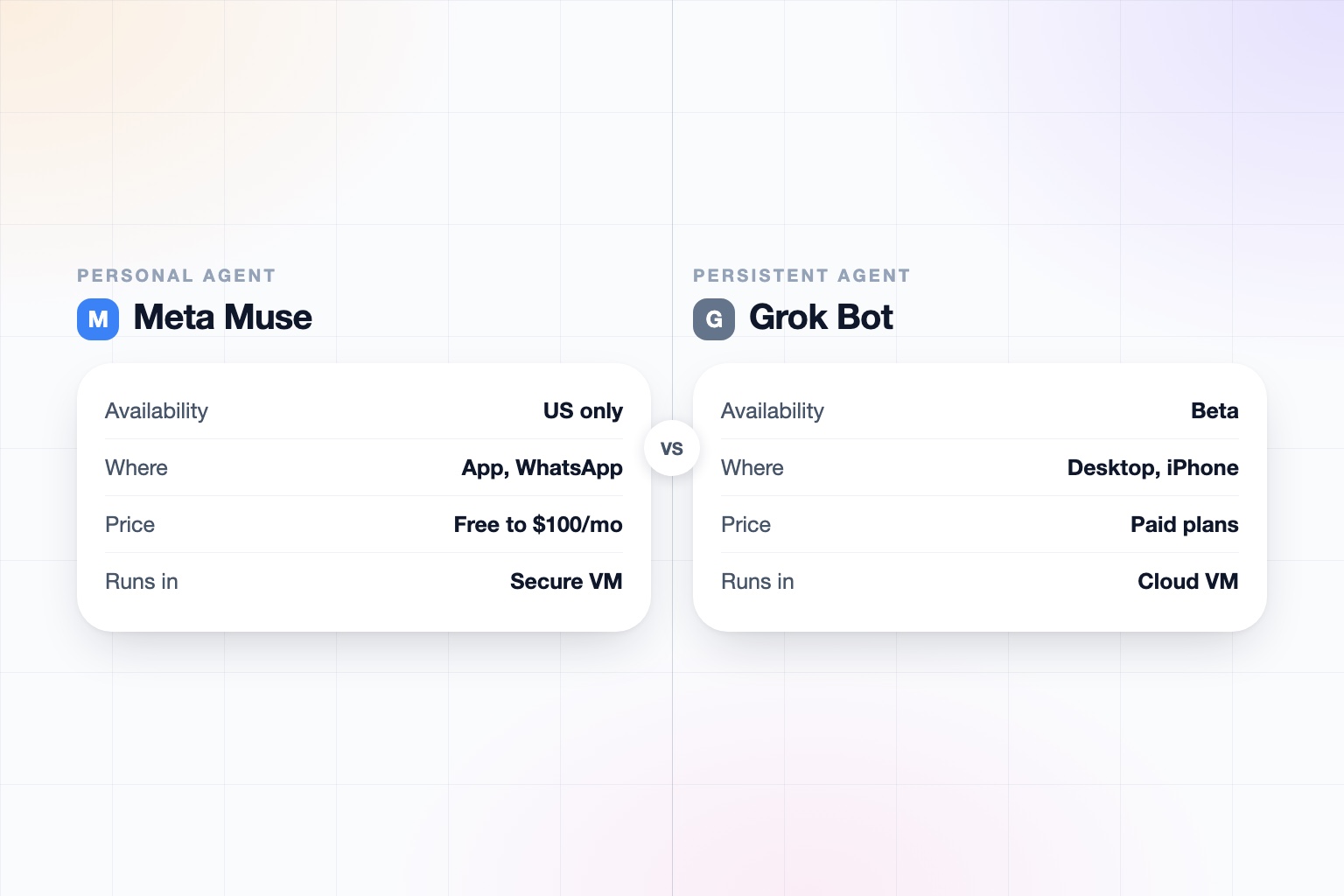
The short answer
Meta Muse is the consumer agent for everyday errands, and Grok Bot is a more technical agent that lives on its own cloud computer and works through your accounts. Muse is easier to start; Grok Bot has deeper tooling and more enterprise-style documentation.
- Pick Meta Muse if you are in the US, want a free tier, want to use it from WhatsApp or a phone app, and want an agent that shops, books and pays.
- Pick Grok Bot if you already have SuperGrok Heavy or a paid Cursor plan, work on a desktop, and want a persistent bot that handles multi-step work in legacy tools and runs routines.
Both are early, and neither gives the agent its own phone number. If you are picking for a team, also read AI beyond ChatGPT for business.
Meta Muse vs. Grok Bot at a Glance
| Meta Muse | Grok Bot | |
|---|---|---|
| What it is | Meta's consumer personal AI agent, launched September 8, 2026 | xAI's persistent named agent on an account-scoped cloud VM, beta launched August 11, 2026 |
| Who it is for | Individual consumers; one owner per agent | Technical users and paid subscribers; team and enterprise access promised |
| Availability | US only at launch; card required to start | Early beta; via SuperGrok Heavy or paid Cursor plans; usage resets weekly |
| Where you use it | muse.ai, iOS, Android, WhatsApp chats | Desktop apps (macOS, Windows, Linux) plus iOS and Android apps, per xAI docs |
| Its own identity | Own browser in a Muse Secure VM; own email announced as coming soon | None documented; acts as you inside your own logins; bots have names only |
| What it can do for you | Sends email, books travel, fills forms, browses, negotiates, pays via Link by Stripe | Signs into apps and does multi-step work using a browser, filesystem, terminal, and MCP |
| Contacting outside people | Sends email and negotiates; no confirmed outbound calls found | Acts through your accounts; phone or voice calls not documented |
| Multi-person or team support | One owner per agent; no group support found | Multiple bots coordinate in group chat; multi-user features conflict across sources |
| Workflows and automation | Background runs; no workflow builder documented | Routines on schedule or events, 50 per bot; learns skills from up to 10 minutes of browser demonstration |
| Payments | Link by Stripe; PayPal named at Connect | Stops for payment entry; approval required for buying |
| Privacy and training | Training on interactions on by default, opt-out in Settings; not shared with Meta ad systems | Grok Business and Enterprise say no training on customer data; consumer terms not confirmed here |
| Security and compliance | No SOC 2, ISO, HIPAA, or GDPR certifications found | Reworked reports SOC 2 Type II and GDPR; ISO 27001 and 42001 in progress (secondary source) |
| Pricing | Free tier, Power $20 per month, Maximum $100 per month | Price not stated here because sources conflict; confirm on x.ai |
Details reflect public sites, documentation, and press coverage as of September 2026. Both products change quickly, so re-check before relying on any single row.
What is Meta Muse?
Muse is Meta's consumer personal AI agent, launched on September 8, 2026. It is distinct from the Muse Spark models and from Meta Business Agent for WhatsApp Business.
It runs in the background in a Muse Secure VM with its own browser, and can send email, book travel, fill forms, browse, negotiate, and pay through Link by Stripe. Connectors span email, calendar, payments, health, smart home, dining, shopping, music and events, and Meta named partners including Shopify, Best Buy, Walmart, Expedia and Instacart, plus GitHub, Notion and Granola.
Meta also announced, at Connect on September 23, a wake word for AI glasses, a Realtime Avatar, Mac desktop control, and a Muse email address. Those are still ahead.
What is Grok Bot?
Grok Bot is the official name of xAI's agent product, in beta since August 11, 2026 (docs.x.ai/grok-bot). It is separate from @grok, the reply chatbot on X, from Grok Tasks (scheduled prompts), and from Grok Business and Enterprise, which are team chat plans.
A Grok Bot is a persistent, named agent on an account-scoped cloud VM with a browser, filesystem, terminal and MCP. It signs into apps, does multi-step work, and keeps running when your laptop is closed. Multiple bots can run in parallel and coordinate in group chat, and a bot can learn a skill from up to 10 minutes of browser demonstration.
One security note from the documentation: all bots share one VM and are not separate security boundaries.
Is Grok Bot free? Access and pricing compared
Grok Bot is not free, and it is not open to everyone. Access is through SuperGrok Heavy or any paid Cursor plan, on desktop and iOS, with usage that resets weekly. Team and enterprise access was promised for the coming weeks at launch. Prices reported for it conflict across sources, so we are not quoting one; confirm on x.ai.
Meta Muse has a free tier and open sign-up in the US. TechCrunch reported a free tier with a usage meter, Power at $20 per month, and Maximum at $100 per month. A card is required to start.
If cost and ease of trying matter most, Muse is simpler. Our pricing page and the best AI personal assistants of 2026 show how the field compares.
Head to head: what each can actually do
- Muse's edge is consumer breadth: shopping, travel, payments, WhatsApp, and a big partner list, with permission checks for emails and purchases enforced outside the model.
- Grok Bot's edge is depth: a persistent VM that can handle legacy tools with no API by falling back to computer vision and browser use, parallel bots, 50 routines per bot on schedules or events, and a connector list that includes Gmail, Google Calendar, Drive, Outlook, Teams, SharePoint, Salesforce, Slack, Notion, GitHub and Jira, with a 220-plugin catalog reported by Reworked.
- Muse's gap: one owner per agent and no workflow builder we could find.
- Grok Bot's gap: an app install rather than a text thread, early beta, and no documented phone or email channel to reach it. A third-party review found no email, Slack, Telegram or phone channel, though Slack and GitHub can trigger routines.
For a sense of which chores suit an agent, see tasks to automate with AI and how to use AI at work.
Does it have its own phone number or email?
Neither has a documented phone number. Muse runs in its own VM and browser, and its own email address is promised soon. Grok Bot has none documented: it acts as you inside your own logins, and its bot names are not an external identity.
That has a practical effect. Grok Bot needs approval for sending, publishing, buying and deleting, and stops for passwords, 2FA and payment entry, which keeps you in the loop. Muse handles payments through Link by Stripe and hides passwords and payment details from the model in a Secure Credentials Store.
Privacy and security compared
Muse trains on interactions by default with an opt-out in Settings, Data controls. Meta says it strips names, emails, phone numbers and SSNs, does not share data with its ad systems, and can delete or forget items on request. We found no SOC 2, ISO, HIPAA or GDPR certifications for it.
Grok Bot is stronger on paper for organizations. Reworked reports SOC 2 Type II, GDPR, annual pentests, and ISO 27001 and 42001 in progress, and xAI's Grok Business and Enterprise plans say customer data is never used for training and offer SSO, SCIM, audit controls and an optional vault with customer-managed keys. Those come from a secondary report and plan announcements, not necessarily the consumer Grok Bot terms, so check what applies to your plan. The guide to judging AI tool safety and our trust page cover what to ask.
Who each is best for
- Muse is best for US consumers who want to start free, use WhatsApp or a phone app, and want an agent for shopping, travel and forms.
- Grok Bot is best for technical users already on SuperGrok Heavy or Cursor who want a persistent desktop-side agent with routines and legacy tool access.
- For team use, neither has a clear multi-user story yet. See the Muse alternative for work and Grok Bot alternative for work, or our teams page.
Related matchups: Instinct vs. Muse, Muse vs. Cue by Manus, and Grok Bot vs. Cue by Manus.
How they differ in one line
Muse is the easy-to-start, free-tier consumer agent for errands and shopping; Grok Bot is the paid, desktop-first, more technical agent with a persistent VM, routines and more documented enterprise-style controls.
Frequently asked questions
Is Grok Bot the same as Grok?
No. Grok Bot is a separate agent product in beta since August 11, 2026. It is distinct from @grok on X, Grok Tasks, and Grok Business or Enterprise.
Is Grok Bot free?
We did not find a free tier. Access is through SuperGrok Heavy or a paid Cursor plan, and reported prices conflict, so confirm on x.ai.
How much does Meta Muse cost?
TechCrunch reported a free tier with a usage meter, Power at $20 per month, and Maximum at $100 per month. A card is required to start.
Does Muse or Grok Bot have its own phone number?
Neither documents one. Grok Bot acts through your own logins, and Muse has announced an email address for itself but no phone number that we found.
Can Grok Bot or Muse be used on Android?
Both have Android apps. Muse also runs inside WhatsApp; xAI's docs list Grok Bot on macOS, Windows, Linux, iOS, and Android.
Do they train on my data?
Muse trains on interactions by default with an opt-out in Settings, Data controls. xAI says Grok Business and Enterprise customer data is never used for training; we did not confirm Grok Bot's consumer terms.
Sources
- Meta: Introducing Muse
- Meta help center: Muse and your data
- xAI docs: Grok Bot
- xAI: Grok Business and Enterprise
Facts last verified 2026-10-01.
More comparisons
- Grok Bot Pricing (2026): What It Costs and Which Plan You Need
- Grok Bot vs ChatGPT for Work (2026): Which Is Better?
- Meta Muse vs Claude Cowork (2026): Which AI Agent Is Better?
- Best AI Personal Assistants and Agents in 2026, Compared
- Instinct vs Meta Muse (2026): Which AI Personal Agent Is Better?
- Muse vs Manus Cue (2026): Which AI Agent Should You Pick?
- Grok Bot vs Cue by Manus (2026): Which AI Agent Wins?
- Instinct vs Grok Bot (2026): Which AI Agent Is Better?
- Claude Cowork vs Grok Bot (2026): Which Agent Is Better?
If your work involves other people
OpenAssistant is our executive assistant for teams, with its own phone number and email. See how it compares:
Keep reading
Guides
- Best AI Executive Assistants in 2026 (Compared)
- Best AI Assistants You Can Text (iMessage, WhatsApp, SMS) in 2026
- Best AI Assistants That Make Phone Calls for You (2026)
- How to Use AI as an Executive Assistant (Step by Step)
- How to Know If an AI Tool Is Safe to Use in 2026
- How to Use AI at Work: 10 Practical Ways in 2026
- How Businesses Can Use AI Beyond ChatGPT in 2026
- 20 Tasks You Can Automate With AI at Work in 2026
- 9 Best AI Calendar Assistants for 2026
- 7 Best AI Email Assistants for 2026